Download
1 / 18
180 likes | 297 Views
This lecture explores the transformation from Non-deterministic Finite Automata (NFA) to Deterministic Finite Automata (DFA). It discusses the uniqueness of paths for strings in DFA compared to multiple paths in NFA. Key points include defining the DFA’s state set based on the NFA’s closure properties and the construction of DFA through various examples, including accepting specific patterns. The process requires attention to ε-closures and allows for the design of finite automata that can accept or reject strings effectively.

E N D
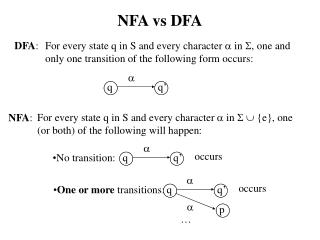
DFA • For every string x, there is a unique path from initial state and associated with x. x is accepted if and only if this path ends at a final state. x
NFA • For any string x, there may exist none or more than one path from initial state and associated with x.
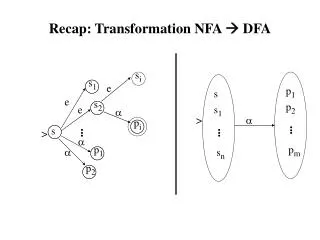
NFA DFA • Consider an NFA M=(Q, Σ, δ, s, F). • For x in Σ*, define [x] = {q in Q | there exists a path s q} • Define DFA M’=(Q’, Σ, δ’, s’, F’}: Q’ = { [x] | x in Σ* }, δ ([x], a) = [xa] for x in Σ* and a in Σ, s’ = [ε], F’ = { [x] | x in L(M) } x
Construction of M’ Special Case: M has no ε-move. • [ε] = {s} • Suppose [x] is known. How to get [xa] for a in Σ?
From [x] to [xa] a • [xa] = { p | there exists a path q p for some q in [x] } = { p | there exists q in [x], q p } = U path a edge δ(q,a) q in [x]
Construction of M’ • F’ = {[x] | x in L(M)} = {[x] | [x] ∩ F ≠ Ǿ }
Example 1 • Construct DFA to accept 00(0+1)* 0 0, 1 0 0 0 0 q s p s q p 1 1 Ǿ 1 0,1
Example 2 • Design DFA to accept (0+1)*11 0 0 1 1 0 s 1 1 s 1 q s p s p p q 0 1
Example 3 • Design DFA to accept 00(0+1)*11 0 0 0 1 1 t s p q r 0,1 Ǿ 1 1 1 0 1 q 1 q 1 0 0 s r q p t r 0 0
Example 4 • Construct DFA M for L(M)=ε. Is this a DFA? s 0,1 0 s Ǿ 1
Example 5 • Construct DFA M for L(M)=Ǿ. Is it a DFA? s 0 s 0,1 Ǿ 0,1 1
Construction of M’ • For q in Q, define ε-closure(q) = {p | there exists a path q p} • [ε] = {q | there is a path s q} = ε-closure(s) • Suppose [x] is known. How to get [xa] for a in Σ? ε path ε path
From [x] to [xa] a • [xa] = { p | there exists a path q p for some q in [x] } = { p | there exists q in [x], q r p } = { p | for some q in [x] and r in δ(q,a), p in ε-closure(r) } = U U ε-closure(r) path a ε edge path r in δ(q,a) q in [x]
Construction of M’ • F’ = {[x] | x in L(M)} = {[x] | [x] ∩ F ≠ Ǿ }
Example 6 • Construct DFA M for L(M)=(0+1)*. 0,1 ε ε s p q 0,1 0,1 s 0 p p q q 1
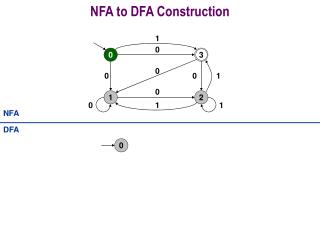
Example 7 • Convert the following NFA to DFA. 0 q 0 0 s ε q r 0 1 ε s 0 r s ε p p r p 1 1 1 0 0 q, r, p 1
0 0,1 0 0 0 0 1 1 1 1 e s a b c d 1 0 0 0 0 0 s,a s,a,b s,a,b,c s,a,b,c,d s,a,b,c,d,e s 1 5 s,b 2 =32 How many states? 1 s,c 4 How many final states? 2 = 16 1 s,d 1 No, it is minimum! Can we simplify it? s,e