Download
1 / 14
140 likes | 270 Views
This lesson provides crucial insights into the order of operations essential for solving math problems with multiple operations. Following the specific order enhances consistency in calculations and prevents ambiguity in results. The rules are as follows: 1) Calculate inside parentheses first, 2) Solve exponents, 3) Perform multiplications and divisions from left to right, and 4) Lastly, execute additions and subtractions from left to right. Engage in practice with various problems to master these concepts and reinforce their importance in accurate mathematical computations.

E N D
Order of Operations Mrs. Hulea July 20, 2010
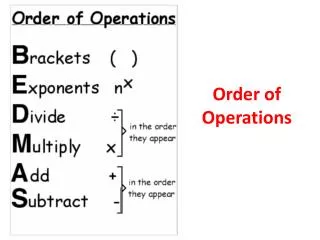
Correct Order • There is a specific order you should use when solving a math problem that has multiple operations. • Rule 1: First perform any calculations inside parentheses. • Rule 2: Do exponents. • Rule 3: Next perform all multiplications and divisions, working from left to right. • Rule 4: Lastly, perform all additions and subtractions, working from left to right.
Operations Basic Math Operations • Addition • Subtraction • Multiplication • Division • Powers and Exponentiation
Order of Operationslink to website Before • There is not a specific order to follow when doing math operations. After • There is a specific order to follow when doing math operations.
9 + 3 - 6 ÷ 2 = • Find the answer to the problem doing any order of operations you choose. • How many different answers did you find? • Find the answer using the Order of Operations. • How many answers did you find?
Why is it important that everyone uses the same order of operations?
4 + 5 * 3 - 1 Calculate 4 + 5 * 3 - 1 26 18 20 14
Calculate 12 - 10 ÷ 2 * 4 + 5 1 -13 8 -3
Assignment • Put a proper heading on your paper. • Calculate the problem using the Order of Operations. • Show your work. • Turn it in before you leave class. 4 + 6 - 8 ÷ 2 * 2 = _______
Credit Slide http://www.mathgoodies.com/lessons/vol7/order_operations.html http://mathforum.org/dr/math/faq/faq.order.operations.html