Electrostatics Chapter 32
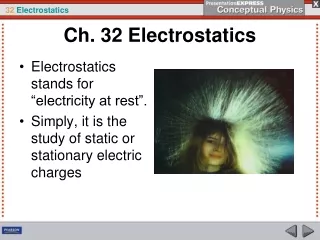
Electrostatics Chapter 32. Electrical forces arise from particles in atoms Electrons are attracted to protons. This holds electrons in orbits around the nucleus of an atom Opposite charges attract Like charges repel All electrons are identical


Electrostatics Chapter 32
E N D
Presentation Transcript
Electrical forces arise from particles in atoms • Electrons are attracted to protons. This holds electrons in orbits around the nucleus of an atom • Opposite charges attract • Like charges repel • All electrons are identical • Atoms usually have as many electrons as protons, so the atom has a net charge of zero. • An ion is produced when an atom gains or loses an electron • An atom with more positive charge than negative charge is called a cation • An atom with more negative charge than positive charge is called an anion
Electrical vs Gravitational Force • Which is stronger? Electrical or Gravitational force? It turns out that Electrical force is 1 x 1036 times stronger than gravitational force! 1,000,000,000,000,000,000,000,000,000,000,000,000 Newtons law of gravitation states that the force of gravity between two objects is proportional to their mass. We feel a strong pull on us due to Earth’s gravity, but this is because the mass of the Earth is very large compared to us. FG = G m1m2 d2
Coulomb’s Law • When an atom becomes positively or negatively charged, there is a transfer of electrons • Conservation of Charge states that at all levels macroscopic or microscopic, electric charge is neither created or destroyed. • Electric force between two objects operates similar manner
q1q2 d2 F = k • The coulomb is the SI unit of charge • 1 coulomb (C) = 6.24 x 10¹⁸ electrons (q) • k = Coulomb’s Law Constant (9 x 10⁹ N*m2/C2) • d = distance between charges
Conductors vs Insulators • Materials through which electrons are able to move easily are called good conductors of electricity • Examples of good conductors: • silver • copper • gold • aluminum • iron • steel • Materials that resist the flow of electrons through them are called good insulators of electricity • Examples of good insulators • rubber • wood • glass • styrofoam
Friction vs Induction • Electrons can be transferred from one surface to another by friction • “If the object is a good conductor, the charge will spread to all parts of its surface because the like charges repel each other” - Hewitt p. 509
Lightning in thunderstorms is produced by friction between water droplets and/or hail within a cloud. Lightning can also be produced by friction between ash particles in volcanic eruptions (above). • http://www.supertightstuff.com/02/02/pictures/tight-pictures/volcanoes-and-lightning/
Electrons can move in a conducting surface when a charge object is moved close to it. This can occur even without contact between the two surfaces. • A charge is said to be induced in the spheres. (see above)