Download
1 / 1
20 likes | 148 Views
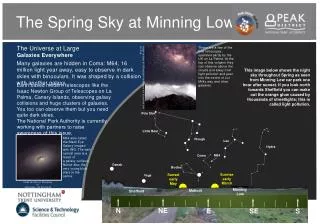
Witness the breathtaking night sky at Minning Low, where the ING telescopes on La Palma unveil the wonders of the universe. From the immense Milky Way to hidden galaxies like M64, 16 million light-years away, these celestial bodies can be observed in the clarity of dark skies, free from light pollution. This seasonal view captures stars and galaxies, including the unique collision remnants within M64. Join efforts by the National Park Authority to combat light pollution and enjoy stargazing in its full glory.

E N D
The Spring Sky at Minning Low The Universe at Large Galaxies Everywhere These are a few of the ING telescopes operated partly by the UK on La Palma. At the top of this volcano they can observe above the clouds and away from light pollution and peer into the centre of our Milky way and other galaxies. Many galaxies are hidden in Coma: M64, 16 million light year away, easy to observe in dark skies with binoculars. It was shaped by a collision with another galaxy. This image below shows the night sky throughout Spring as seen from Minning Low car park one hour after sunset. If you look north towards Sheffield you can make out the orange glow caused by thousands of streetlights; this is called light pollution. Image courtesy of ING group of telescopes NikSzymanek and Ian King Earth based modern telescopes like the Isaac Newton Group of Telescopes on La Palma, Canary Islands, observing galaxy collisions and huge clusters of galaxies. You too can observe them but you need quite dark skies. The National Park Authority is currently working with partners to raise awareness of this issue. Pole Star Little Bear M64 also called the Black Eye Galaxy imaged with ING. The dark central area is a result of a galaxy collision. Notice also the very young blue stars in the centre. Plough Leo Hydra M64 Coma Deneb Bootes Sunrise early March Sunset early May Vega Image courtesy of ING group of telescopes, NikSzymanek Minning Low Matlock Sheffield NE N S SE E