Analyzing Stock Price Movements of Apple, IBM, and Procter & Gamble: A Data-Driven Approach
This report presents a detailed analysis of stock returns for Apple Inc. (AAPL), IBM, and Procter & Gamble (PG) from April 1997 to January 2009. Using high-frequency data in 8-minute intervals, we examine price movements, jump detection, and significance levels for various market events. Notably, we discuss the implications of the PG earnings warning on March 7, 2000, in the context of Dow fluctuations. Additionally, we explore advanced forecasting techniques using Bayesian methods, improving regression coefficients with high-frequency data.


Analyzing Stock Price Movements of Apple, IBM, and Procter & Gamble: A Data-Driven Approach
E N D
Presentation Transcript
Data Analysis II Derrick Hang February 24, 2010 Economics 201FS
Corrections: The Data Apple Inc. (AAPL): April 16, 1997 – January 7, 2009 2,920 Days IBM (IBM): April 9, 1997 – January 7, 2009 2,925 Days Proctor Gamble Co (PG): April 9, 1997 – January 7, 2009 2,924 Days * *Absence of a day from PG was found to be on March 7, 2000; this is when PG released a warning that earnings for the rest of the fiscal year will fall short of expectations, contributing 142 to the 374 point drop in the Dow that day
Modifications 8 minute intervals are used so the intervals fit exactly with the 385 minutes per day window; in other words, there is no incomplete interval left over at the end of each day i.e. to obtain the first 8-minute return you take the price level at the 1st min. and the 9th min., then the 9th and the 15th, etc.; following this sequence, we end up using the price level at the 385th and 377th min. 8 minute is consistent with the volatility signature plots presented last time, and leaves no incomplete interval at the end
IBM • 0.1% Significance Level = 75 / 2925 (2.56%) • 1% Significance Level = 219 / 2925 (7.49%) • 5% Significance Level = 539 / 2925 (18.43%) Corrected MA TP Jump test • PG • 0.1% Significance Level = 82 / 2924 (2.80%) • 1% Significance Level = 223 / 2924 (7.63%) • 5% Significance Level = 548 / 2924 (18.74%) • AAPL • 0.1% Significance Level = 113 / 2920 (3.87%) • 1% Significance Level = 305 / 2920 (10.45%) • 5% Significance Level = 625 / 2920 (21.40%)
IBM • 0.1% Significance Level = 80 / 2925 (2.74%) • 1% Significance Level = 236 / 2925 (8.07%) • 5% Significance Level = 559 / 2925 (19.11%) Corrected MA QP Jump test • PG • 0.1% Significance Level = 94 / 2924 (3.21%) • 1% Significance Level = 238 / 2924 (8.14%) • 5% Significance Level = 563 / 2924 (19.25%) • AAPL • 0.1% Significance Level = 136 / 2920 (4.66%) • 1% Significance Level = 326 / 2920 (11.16%) • 5% Significance Level = 653 / 2920 (22.36%)
AAPL Jump Detection: Median Test • 0.1% Significance Level = 65 / 2920 (2.23%) • 1% Significance Level = 143 / 2920 (4.90%) • 5% Significance Level = 328 / 2920 (11.23%)
IBM Jump Detection: Median Test • 0.1% Significance Level = 57 / 2925 (1.95%) • 1% Significance Level = 126 / 2925 (4.31%) • 5% Significance Level = 278 / 2925 (9.50%)
PG Jump Detection: Median Test • 0.1% Significance Level = 61 / 2924 (2.09%) • 1% Significance Level = 143 / 2924 (4.89%) • 5% Significance Level = 285 / 2924 (9.75%)
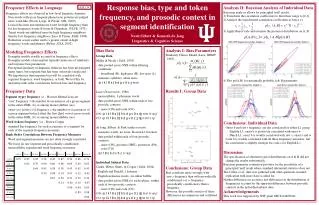
Exploring topics: Forecasting Bayesian Forecasting with Dynamic Models using high-frequency data Regression where every variable varies with time Better coefficients from use of high frequency data? What time window has better predictability? What should be the dependent: returns, prices, volatility?