Understanding the Endocrine System: Hormones and Gland Functions
The endocrine system is vital for coordinating and directing cellular activities throughout the body, functioning in tandem with the nervous system. Unlike the fast-acting, specific signals of the nervous system, hormones released into the bloodstream provide widespread, long-lasting effects. Hormones, classified as steroid or nonsteroid, bind to specific target cells through receptors to regulate important bodily functions including reproduction, growth, metabolism, and homeostasis. The hypothalamus and pituitary gland play crucial roles in managing hormone release through a negative feedback loop ensuring balance in the body.

Understanding the Endocrine System: Hormones and Gland Functions
E N D
Presentation Transcript
Function • Coordinates and directs the activity of the body’s cells • This is the same function of the nervous system • However: • Nervous system: signals are specific and fast-acting • Endocrine system: signals are wide-spread and long-lasting
Physiology: How does it work? • Hormones: chemical messengers that are released into the bloodstream and transported throughout the body • A given hormone only affects certain tissues or organs • Referred to as target cells or target organs
Lock and Key Model • Only certain hormones will affect certain organs because of the presence of the right receptor
Hormones • 2 classes: • Steroid hormones: comprised of fats • Nonsteroid hormones: comprised of proteins or amino acids
Steroid Hormones • Hormones can pass straight through the cell membrane • Often derived from cholesterol • Lipid soluble • Let’s draw our own picture!
Nonsteroid Hormones • Hormones interact with the cell’s plasma membrane and initiate a cascade of signals that will occur within the cells • This is known as a second messenger system • Hormone = first messenger • Cascade of messengers and signals within the cell = second messenger • Let’s draw our own picture!
What do hormones control? • Reproduction • Growth and development • Mobilizing body’s defenses • Maintaining chemical homeostasis • Cellular metabolism and energy balance
How do hormones provide control? • Negative feedback • Hormones secretion inhibits further hormone release • Example: Ovaries release a hormone called estrogen. • When the ovaries release enough hormone to cause a slight increase in concentration in the blood, the ovaries stop secreting hormone • Let’s draw a picture of this!
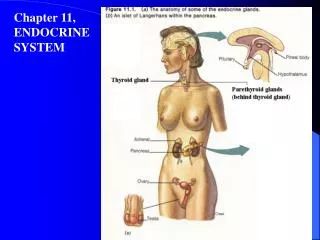
Glands • There are many major endocrine glands in the body • Examples: • Hypothalamus • Pituitary • Thyroid • Parathyroid • Thymus • Adrenal gland • Pancreas • Ovary • Testis • Pineal Gland
Glands • The hypothalamus and pituitary glands are the head honchos of the endocrine system • In charge of controlling the release of all other hormones
Pituitary Gland • Controlled by the hypothalamus • Size of a grape • Sits on a bone called the sellaturcica (Turkish saddle) • 2 functional lobes • Anterior pituitary • Glandular tissue • Posterior pituitary • Nervous tissue
Pituitary Gland: Anterior Lobe • The anterior portion secretes hormones called tropic hormones • Stimulate target organs • Some are endocrine and some nonendocrine • All tropic hormones are • Nonsteroid hormones • Question: Where is the receptor located on the target cell? • On the plasma membrane!
Pituitary and Hypothalamus relationship • Anterior pituitary is controlled by the hypothalamus • The hypothalamus produces releasing and inhibiting hormones that control the release of the tropic hormones into the bloodstream
Hypothalamus Hormones • The releasing hormones are really easy to remember! • If the anterior pituitary is secreting growth hormone (GH), it was stimulated by growth hormone releasing hormone (GHRH) from the hypothalamus
Releasing Hormones • Predict: What tropic hormones will be secreted when the pituitary is stimulated with the following hormones? • Thyroid releasing hormone? (TRH) • TSH • Corticotropin-releasing hormone? (CRH) • ACTH • Gonadotropin-releasing hormone? (GnRH) • FSH/LH
Putting it all together with negative feedback • All of the hormones we have talked about exhibit negative feedback • Releasing hormone tropic hormone hormone • That is, the release of the target organ’s hormone will REPRESS the release of the hypothalamus and pituitary hormones
Focus: Thyroid • 1) hypothalamus secretes TRH • 2) TRH stimulates the anterior pituitary to release TSH • 3) TSH travels to target organ (thyroid) • 4) Thyroid produces thyroid hormone
Thyroid Hormone • Function: Increase a person’s basal metabolic rate (BMR) (speed up their metabolism) and increase heat production • Question: If thyroid hormone exhibits negative feedback of further thyroid hormone production, excess thyroid hormone would cause ____________ and ___________ to stop being released. • TSH and TRH • This is negative feedback at work, folks!
Too Much? To Little? • Hyperthyroidism: excessive production of thyroid hormone • Causes Graves’ disease • Symptoms: constant feeling of warmth (as a result of increased BMR), weight loss, nervousness, and enlarged thyroid gland (goiter) • Hypothyroidism: decreased production of thyroid hormone • Symptoms: lower BMR (intolerance of cold), decreased appetite, weight gain
Focus: Adrenal Glands • 1) hypothalamus releases CRH • 2) CRH stimulates the anterior pituitary to release ACTH • 3) ACTH travels to target organ (adrenal glands) • 4) Adrenal glands produce cortisol
Question • If there is a high concentration of cortisol in the blood, the hypothalamus will release _______________ CRH. • A: more • B: less • CRH ACTH Cortisol
Cortisol • Function: promotes the breakdown of proteins and fats and helps the body adapt to stress • Provide the body with fuel to break down materials in the body • Can also act as an immunosuppressive and anti-inflammaory • Can shrink organs in the immune system • Ie thymus gland
Too Much? Too Little? • Hypercortisolism: excessive amount of cortisol • Causes Cushing’s syndrome • Symptoms: personality changes, hypertension (high blood pressure), osteoporosis, and weight loss • Hyposecretion: decreased secretion of cortisol • Symptoms: defective metabolism, mental confusion, decreased ability to adapt to stress
Focus: Gonads • 1) hypothalamus releases GnRH • 2) GnRH stimulates the anterior pituitary to release LH • 3) LH travels to the gonads (ovaries and testes) • 3) Gonads secrete sex hormones (estrogen and testosterone)
Testosterone • Function: Secondary sex characteristics of males • Increased body hair and deeper voice
Too Much? Too Little? • Too much testosterone? • Increased muscle mass • Male pattern baldness • Acne • Premature sexual development • Decreased amount of testosterone? • Abnormal sexual development • Low sperm count
Rule of Thumb • The more a gland is activated, the larger it gets • Known as hypertrophy (an increase in size) • Think about a person lifting weights—the more you use that muscle, the bigger your muscles get! • If a gland is continually inhibitied, it will shrink in size • Known as atrophy(shrinking in size)
Predict: • Let’s say your glands are 100% normal and they are working properly. • However, your target organs changed their “locks” AKA their receptors • Would they be responsive to hormones? • What would happen if a person with an XY chromosome was born with an insensitivity to testosterone?
Androgen Insensitivity Syndrome • The receptors on the target cells for testosterone (for example, the ones in the gonads) are unresponsive to testosterone • This would have occurred since birth—this is a congenital disease • The female set-up is default • Without testosterone, you would end up looking like a female on the outside • These individuals spend their whole lives thinking that (and looking like) they are female until puberty • They would grow the secondary sex characteristics (breasts), but menstruation would not occur • This is usually the time when they diagnose this disease • https://www.youtube.com/watch?v=JjI-RvkjujI