Download
1 / 10
100 likes | 210 Views
This study explores the fabrication of nanopatterned surfaces for applications in biosensors, tissue engineering scaffolds, and bio-MEMS using nanoscale orthogonal biofunctionalization. The process involves Step and Flash Imprint Lithography with quartz templates and bottom antireflective coatings to achieve high-resolution patterning. Results demonstrate the successful biofunctionalization of surfaces with different molecules and cells, enabling potential advancements in various fields. The method provides a cost-effective and efficient approach for creating functional nanoscale patterns on substrates.

E N D
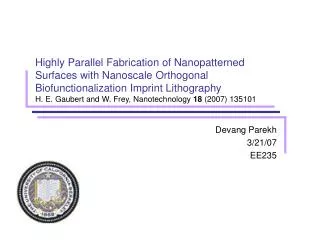
Highly Parallel Fabrication of Nanopatterned Surfaces with Nanoscale Orthogonal Biofunctionalization Imprint LithographyH. E. Gaubert and W. Frey, Nanotechnology 18 (2007) 135101 Devang Parekh 3/21/07 EE235
Overview • Motivation • Fabrication • Results • Conclusion
Motivation • Nanopatterned surfaces • Biosensors • Tissue engineering scaffolds • Bio-Mems • Self-assembly techniques • Pattern parameters • Pattern defects • Lack of dual functionality • E-beam and Ion-beam • Serial • Cost prohibitive
Fabrication • Step and Flash (SFIL) • Quartz template • Bottom Antireflective Coating (BARC) planarization layer • BARC spin-coated 45nm • Low-viscosity resist • Photoresist fills template • Harden PR with UV exposure • Step M. Stewart, et. al, J. Microlith., Microfab., Microsyst. 4, 011002 (2005)
Fabrication • O2 etch residual photoresist • 2nd O2 etch to transfer pattern to BARC • Evaporate 3nm of Cr • Evaporate 17nm of Au • Lift-off
Fabrication • O2 plasma remove residual organics • Hexadecanethiol (HDT) • Polyethylene Glycol-silane (PEG-silane) • Fibronectin • Human umbilical vein endothelial cells (HUVECs)
Results • AFM physico-chemical mapping • Force is random for untreated • HDT is hydrophobic • PEG is less hydrophilic than clean wafer • nm-resolution of physico-chemical differences
Conclusion • Soft litho->micro NOBIL->nano • Orthogonal functionalization shown • Simple and cheap fabrication • Possible extension to glass or polymer substrates