Modality Preferences
Explore the three primary learning modalities: visual, auditory, and kinesthetic. Visual learners excel through seeing and recalling visual aids such as illustrations and lists. Auditory learners thrive on listening and interpreting information through tone and speech. Kinesthetic learners need hands-on experiences and prefer writing to engage with new material. Each style has unique characteristics that influence productivity and engagement in learning environments. Recognizing these preferences can enhance teaching methods and improve learning outcomes for individuals.

Modality Preferences
E N D
Presentation Transcript
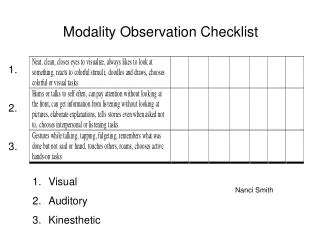
Visual • Visual learners learn through seeing. With their primary perceptual preference being visual, they can typically recall what they have read or observed. • They prefer to look at illustrations, or watch others doing something, rather than listening only. • They are the learners that usually take and make lists. • In addition, they tend to be more productive when their environments are neat.
Auditory • Auditory learners prefer to listen. • They are usually able to memorize what they hear and tend to be very attentive when information is presented in this way. • They search for meaning and interpretation in lectures or speeches by listening to tone of voice, pitch, speech, and other special signals. • These learners need to be told what to do rather than having them read directions.
Tactile/Kinesthetic • Kinesthetic learners need to write things down. • They like to incorporate their fine motor skills. • They are the learners that like to take notes as they listen, and keep their hands busy. • Kinesthetic learners need to use their bodies in the learning process. They need to do, not just watch or listen, to gain understanding