Understanding Continuous and Discrete Distributions: Uniform, Normal, and Exponential
This comprehensive guide provides an overview of continuous and discrete distributions, focusing on Uniform, Normal, and Exponential distributions. Learn about the characteristics of these distributions, including how to use normal approximations for other distributions and the relationship between Exponential and Poisson distributions. Important concepts such as the memoryless property of the Exponential distribution and the method of estimating means and variances are also discussed. This resource is essential for grasping fundamental statistical concepts and preparing for assessments.

Understanding Continuous and Discrete Distributions: Uniform, Normal, and Exponential
E N D
Presentation Transcript
Uniform • The probability of each X in the interval is “uniform” (the same) Uniform can be discrete (ex: dice only have integers) or continuous (all values in interval)
Uniform: Discrete vs. Continous Discrete Continuous
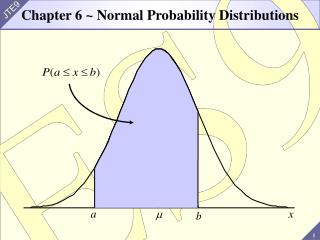
Normal Distribution • Notation: X ~ N(mean, variance) • Note: the second number is variance not standard deviation • Ex: Standard Normal, Z ~ N(0, 1) • You will likely not need to know the pdf • You will be given a normal table to find common z values • One-sided: use the (1 – alpha) percentile • Two-sided: use the (1 – alpha/2) percentile • P(r<X<s) = P[(r-µ)/σ < (X-µ)/σ < (s-µ)/σ ] • Be comfortable using the table!!!
Normal Approximation of Other Distribtutions • Given RV X, mean, and variance of the distribution (without knowing what the real distribution is) • Use normal distribution with the same mean/variance to approximate the true probability • Integer Correction for Discrete Distributions • P(n<=X<=m) becomes P(n-1/2<=X<=m+1/2) • Explained/justified well in Actex (see p. 200) • You’ll likely still be closest to the right answer without this, but it’s more accurate this way
When do I divide by sqrt(n)? • Estimating a value (X) • No square root of n • Estimating a mean (X bar) given a sample size • Involves square root of n • (ex: SOA 123 #81) • Hint: you only use n when given a sample size, and it’s used to decrease the size of the interval b/c an average is less variable • Note: the sample size does not affect the mean, only the variance
Exponential Distribution • Usage: X is time until an event occurs • Parameter: Lamba (mean = 1/Lambda) • Alternative: Use Theta = 1/Lambda • Theta = Mean • Can rewrite pdf, E[X], Var[X], etc. using Theta
“Memoryless” Property • Concept: what happened before doesn’t affect what’s going to happen now • Exponential is about time until an event occurs • Ex: if no insurance claims have happened in the past month, the exponential doesn’t think that one is “due” now • There is just as much chance of a claim happening this week as there was in the week following the first claim
Link Between Exponential and Poisson Distributions • These distributions are connected by the same parameter: Lambda • X is the time between events (continuous) • time per events • X ~ Exponential, with mean (1/Lambda) • Ex: time between claims • N is the number of events that have occurred while that time elapsed (discrete) • events per time • N ~ Poisson, with mean Lambda • Ex: number of claims in a period of time
Minimum of Multiple Exponential RV’s • Given multiple RV’s with exponential distributions and their means (1/Lambda), find some probability involving the minimum of all of the RV’s (the lowest value of all of the RV’s the time at which the first event occurs) • An RV with a higher mean may still occur before the lower means (due to randomness) • Trap: do not just add the means of the exponential distributions • Technique • Convert to Poisson distributions, each with mean Lambda • Add the Lambda’s • This new Lambda is the parameter for Y = min{Y1, Y2, …, Yn} • Y ~ exponential with mean (1/Lambda) • Key Point: don’t add the means of the exponentials, convert to lambda’s, add the lambda’s, convert back to exponential • This is a harder problem, but VERY COMMONLY TESTED
Gamma Distribution • Actex does not recognize this as an important distribution to know • Uniform, Normal, and Exponential are the MOST important f(x) = βα*xα-1*e-βx Γ(α) Γ(n) = (n-1)! (if n is a positive integer) E(X) = α/β Var(X) = α/β2