Download
1 / 11
110 likes | 242 Views
In this lesson, students will gain the skills to find the five-number summary and create box plots both by hand and using a calculator. Focusing on Exploratory Data Analysis (EDA), we delve into traditional statistics methods, including frequency distributions, mean, and standard deviation while emphasizing the median and interquartile range. Students will explore the structure of box plots and their importance in visualizing data distribution and spread. Practice examples will include constructing box plots for real datasets and commenting on their distributions.

E N D
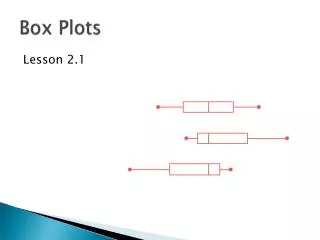
Box Plots • SWBAT: Find the 5-number summary and create box plots by hand and on a calculator. • Quiz (tomorrow: 3-1 through 3-3) • Warm-up: Pg 154 #22 • HW?s • Notes • Assignment
Exploratory Data Analysis (EDA) • Traditional Stats uses frequency distributions from which various graphs can be constructed. Uses mean and standard deviation. Used to confirm conjectures about the nature of the data. • EDA uses stem-leaf plots and box plots. Uses median and IQR. Used to look at center and spread of data.
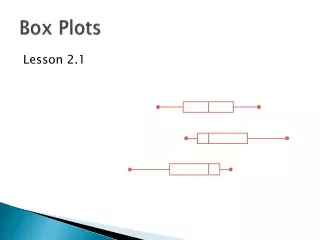
3.4 Exploratory Data Analysis The Five-Number Summary is composed of the following numbers: Low, Q1, MD, Q3, High The Five-Number Summary can be graphically represented using a Boxplot. Bluman, Chapter 3 5
Procedure Table Constructing Boxplots Find the five-number summary. Draw a horizontal axis with a scale that includes the maximum and minimum data values. Draw a box with vertical sides through Q1 and Q3, and draw a vertical line though the median. Draw a line from the minimum data value to the left side of the box and a line from the maximum data value to the right side of the box. Bluman, Chapter 2 6
Example 3-38: Meteorites The number of meteorites found in 10 U.S. states is shown. Construct a boxplot for the data. 89, 47, 164, 296, 30, 215, 138, 78, 48, 39 30, 39, 47, 48, 78, 89, 138, 164, 215, 296 Five-Number Summary: 30-47-83.5-164-296 Q1 Low MD Q3 High 47 83.5 164 296 30 Bluman, Chapter 3 7
A dietitian is interested in comparing the sodium content of real cheese with the sodium content of cheese substitute. The data for two random samples are shown. Compare the distributions using boxplots. Low High MD Q1 Q3 Low High MD Q1 Q3
Example #2: Pg 167 #12 Construct a boxplot for the following data which represent the number of innings pitched by the ERA leaders for the past few years. Comment on the shape of the distribution. 192 228 186 199 238 217 213 234 187 214 115 238 246