Download
1 / 18
180 likes | 312 Views
The muscular system plays a vital role in body movement, blood circulation, digestion, and respiration. It comprises three types of muscles: smooth, skeletal, and cardiac. Smooth muscles control involuntary movements in organs, skeletal muscles facilitate voluntary movements, and cardiac muscles contract the heart rhythmically. Proper care of the muscular system is essential to prevent issues such as atrophy, soreness, and injuries. Regular exercise, a balanced diet, and safety practices, including stretching and warm-ups, are crucial for maintaining muscle health.

E N D
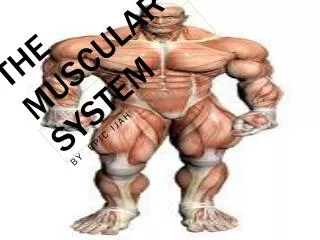
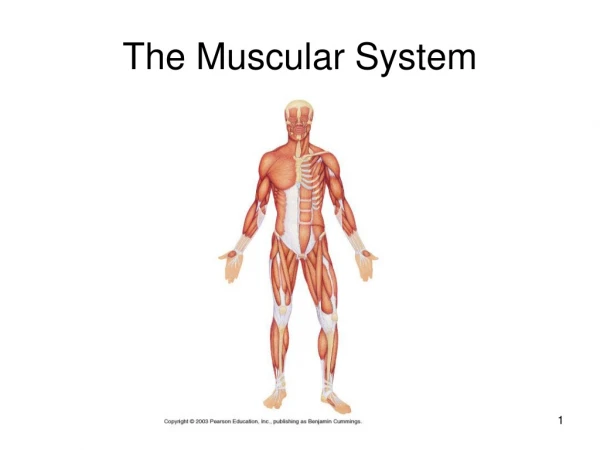
THE MUSCLAR SYSTEM • FUNCTIONS: • Body Movement • Pump Blood Throughout body • Move food through digestive system • Control air movement in and out of the lungs
CONTRACTION • CONTRACTION: Shortening of a muscle. • EXTENSION: stretching of a muscle.
ANTAGONISTIC • Muscles work in opposition, while one contracts, the other extends. • Antagonistic = work in opposition, muscles do this, so one muscle would be the antagonistic muscle to another one. • Examples = bicep/triceps quadriceps/hamstrings
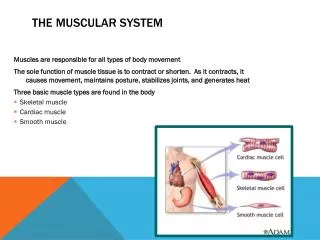
TYPES of MUSCLES • SMOOTH MUSCLE: control movements of internal organs. • Involuntary movements…work without conscious control. • Intestines, bronchi of the lungs, the bladder.
TYPES of MUSCLES… • SKELETAL MUSCLE: striped or striated muscles attached to the bones that cause body movement. • Biceps, triceps. • Largest part of the body’s muscular system. • Voluntary movements, conscious control. • FLEXORS: muscles that close a joint. • EXTENSORS: muscles that open a joint.
TYPES of MUSCLES… • CARDIAC MUSCLE: striated tissue that forms the wall of the heart. • Involuntary muscle. • Heart contracts rhythmically about 100,000 times a day.
CARE of the MUSCLE SYSTEM • ATROPHY: waste away (“Use it or lose it”) • MUSCLE TONE: the natural tension in the fibers of a muscle. • Aerobic exercise, resistance training, balanced diet. • Older adults…prevent loss of mobility, balance, and risk of falls. • The heart is a muscle that needs “training”…regular exercise. • Stretching, warm-up, cool down. • As always safety.
PROBLEMS of the MUSCULAR SYSTEM • MUSCLE SORENESS: damage to the muscle fibers themselves. Muscle biopsies taken on the day after hard exercise show bleeding and disruption of the z-band filaments that hold muscle fibers together as they slide over each other during a contraction.
PROBLEMS of the MUSCULAR SYSTEM • MYASTHENIA GRAVIS: muscles become weak and easily fatigued. • Eye muscles…drooping eyelids and double vision. • MUSCULAR DYSTROPHY: inherited disorder characterized by a progressive wasting away of skeletal muscles. • No cure.
PROBLEMS of the MUSCULAR SYSTEM • MUSCLE STRAIN: • “pulled muscle”, tearing or stretching of muscles fibers as a result of suddenly pulling them to far.
PROBLEMS of the MUSCULAR SYSTEM • BRUISE: discolored area under the skin caused by a leakage of blood after an injury. After Femur fracture
PROBLEMS of the MUSCULAR SYSTEM • TENDINITIS: the inflammation of a tendon, usually caused by overuse.
PROBLEMS of the MUSCULAR SYSTEM • HERNIA: the protrusion of an organ of tissue through a weak area in the muscle.
Additional Information • Cartilage = allows smooth movement at a joint – connects the ribs and is a cushion between vertebrae. • Ligaments = connect bone to bone at a joint. • Tendons = a band of fiber that connects muscles to bones.
What are muscles made of? • Muscle tissue is • ¾ water • The remaining ¼ is • 20% protein substances • 5% nonprotein and mineral substances.
What is ATP? • Adenosine Triphosphate is a nonprotein chemical substance in muscle tissue. It is a source of immediate energy for muscle contraction. What is Glycogen? - An organic compound in muscles. Stored in cells and used as the body needs energy.