Download
1 / 12
120 likes | 218 Views
Delve into the complexities of why regimes commit to human rights treaties, exploring the balance between sovereignty and international accountability. Join instructor James Raymond Vreeland in examining the political regime's role in this decision-making process. Unlock the puzzle of Europe post-WWII and the European Convention for the Protection of Human Rights and Fundamental Freedoms (ECHR). Explore the concept of "LOCK-IN" and how it influences democracies, dictatorships, and new democracies differently. Discover the significance of effective supranational adjudication in Europe and the implications for political uncertainty and regime survival. Utilize STATA for an alternative testing approach drawing on democracy survival theory. Uncover how domestic political determinants shape international relations in the context of human rights enforcement.

E N D
Why Do Regimes Commit to Human Rights Treaties? The United Nations Human Rights Conventions Instructor: James Raymond Vreeland
Central question in today’s class:Why sacrifice sovereignty? • A central question throughout the course • The logic may depend on political regime
The Wimpy Story Brought to you by: Moravcsik, Andrew. 2000. The Origins of Human Rights Regimes: Democratic Delegation in Postwar Europe. International Organization 54 (2):217–52.
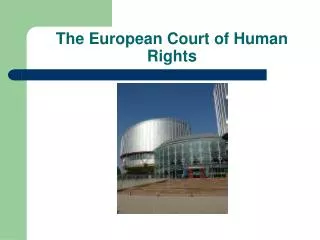
New Puzzle: Europe post-WWII • Regarding: European Convention for the Protection of Human Rights and Fundamental Freedoms (ECHR) • Who supports strict enforcement?
Why are democracies willing to sacrifice sovereignty? • Because they are UNSURE of their survival • If they fear the return of autocracy, • They want to hand over prosecutorial authority to an international body • They give up some power so that their potential successors won’t have it either • Does this make dictatorship less valuable? • Perhaps this makes democracy more likely to endure?
We call this story: “LOCK-IN”
Lock-in • European Convention for the Protection of Human Rights and Fundamental Freedoms (ECHR) established a Commission on Human Rights • could investigate the case, seek to settle it, or forward it under certain circumstances to a court of human rights, whose decisions governments are legally bound to follow • Two optional clauses of the ECHR, Articles 25 and 46, were subsequently adopted by all member states • they permit individual and state-to-state petitions and recognize the compulsory jurisdiction of the court • Parties to the ECHR must subject themselves to the Court’s jurisdiction • Established “effective supranational adjudication” in Europe • Established-democracies & dictatorships opposed binding human rights enforcement (“sovereignty costs”) • But for NEW DEMOCRACIES, the benefits of reducing future political uncertainty outweigh the “sovereignty costs” • “self-binding” or “lock-in” is useful to newly established democracies
Alternative way to test • STATA! • Draws on theory/empirics regarding the survival of democracy (Przeworski et al. 2000. Democracy & Development) • Uses “contested elections” & “per capita income” instead of “undemocratic”/“newly established”/“established democracy”
Moravcsik Predictions: • Dictatorships do not want to cede authority • They commit torture! (So they really lose from enforcement regime) • Established democracies do not want to cede authority • They gain nothing (and potentially lose – just in case they want to have the ability to torture) • Democracies “at risk” want to cede! • They want to establish human rights – enforced from outside, in case democracy collapses!
Take-away • Domestic political determinants of international relations!