Download
1 / 15
160 likes | 315 Views
This comprehensive overview explores the principles of gas exchange, focusing on the transfer of oxygen and carbon dioxide in various organisms. All respiratory surfaces share a common trait: they must be moist for optimal gas exchange. Adaptations in gills, lungs, and even in the unique respiration of insects are discussed, highlighting how different species maximize their gas exchange capacity. Additionally, we delve into ventilation mechanisms, the advantages of countercurrent exchange, and the intricate pathways of oxygen as it travels through the respiratory system to tissues like those in the big toe.

E N D
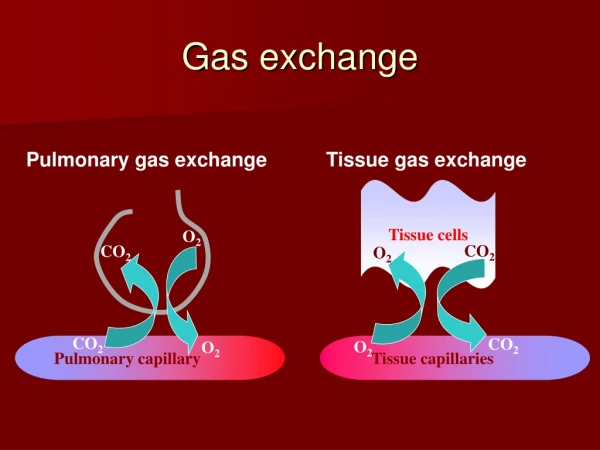
Gas Exchange • The exchange of Oxygen and Carbon dioxide • What characteristic do all respiratory surfaces have in common? • They must be moist • Respiratory surfaces in different animals are adapted for maximal gas exchange capacity
Gills • Ventilation – increasing flow over the respiratory surface • What is the advantage of countercurrent exchange? • How can insects meet their high metabolic demands for oxygen with an open circulatory system?
Lungs • Connects to circulatory system • Located in thoracic cavity, near the heart • Describe the pathway of oxygen to the lungs. • What is the passage of oxygen as it enters your nasal passageway and is used by tissues in your big toe? • How do mammals ventilate their lungs? • What is so special about the avian respiratory system?