Understanding Covalent Compounds: Lewis Dot Structures and Naming Conventions
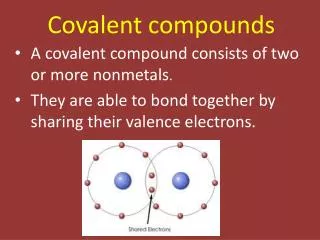
This guide focuses on covalent compounds, detailing how to construct Lewis dot structures and the rules for naming them. Learn to identify valence electrons for each atom and create accurate Lewis structures by combining atoms to ensure each has eight electrons, with exceptions for hydrogen. The guide also covers the naming of simple covalent compounds, emphasizing the order of nonmetals, the use of "-ide" endings, and incorporating prefixes to denote the number of each element. Examples, including nitrogen oxides, illustrate these concepts clearly.

Understanding Covalent Compounds: Lewis Dot Structures and Naming Conventions
E N D
Presentation Transcript
Covalent Compounds Lewis Dot Structures & Naming
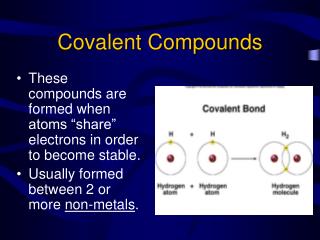
4.Turn pairs of shared e- into () Drawing Lewis Dot Structures Covalent compounds 1. Figure valence e- for each atom 2. Draw Lewis Dot Structure 3.Combine atom so each has 8 e- exception - H - needs 2e- only
H H H O H O H H O H2O(covalent) + Dashes represent 2 shared e-
H H H H H H C H C H H C H H H Example CH4
C C O O O O Lone pair of e- O = C = O Example CO2
Naming compounds - simple covalent Nonmetal farthest left 2. Other non-metal w/ “-ide” ending 3. Add prefixes- # of each element (if needed)
Prefixes mono - 1 di- 2 tri- 3 tetra- 4 penta- 5 hexa- 6 hepta- 7 octa- 8 nona- 9 deca- 10
Examples NO - Nitrogen monoxide NO2 -Nitrogen dioxide N2O - dinitrogen monoxide N2O5 - dinitrogen pentoxide