Understanding Population Dynamics: Growth, Limitations, and Human Impact
This chapter delves into the complexities of population dynamics, highlighting how populations grow and the factors influencing their size and distribution. Key concepts include geographic range, population density, growth rates, and age structure. It distinguishes between exponential and logistic growth, discussing phases of growth and limiting factors that regulate population sizes, such as availability of resources and density-dependent factors. The section also addresses human population growth over time, examining historical trends, demographic transitions, and future projections.

Understanding Population Dynamics: Growth, Limitations, and Human Impact
E N D
Presentation Transcript
5.1 How Populations Grow • Describing Population • Geographic Range: area inhabited • Density and Distribution: • Population Density - # of individuals per unit area • Distribution – individual spacing in a population (random, uniformly, clumping Wild Flowers King Penguin Striped Catfish • Growth Rate: size of population over time (increase, decrease, stay the same) • Age Structure: # and age of males/females
Population Growth • Birthrate & Death Rate: influence whether pop grows, stay the same or decreases • Immigration: moving into range (increased good supply) • Emigration: moving out of range (food shortage)
Exponential Growth: occurs with unlimited resources; # of offspring increases with each new generation • Organisms that reproduce rapidly : (bacteria reproduce very 20 minutes) • J–curve: slow growth first then faster • Organisms that reproduce slowly: • Organisms in new environment: (invasive species: no natural predators)
Logistic Growth • Phases of Growth: • Phase1: Exponential w/initial unlimited resources (few die; many reproducing) • Phase 2. Slows: pop. grows at slower rate • Phase 3. Stops: zero growth rate (curve levels off; pop. can remain here indefinitely)
Logistic Growth Curve: • S-shaped curve • Exponential growth slows, then stops • Decreased birthrate; increased death rate • Decreased immigration; increased emigration
Carrying Capacity: • Max # of species individuals environment can support • Birthrate = death rate; immigration = emigration • Slight pop. change over time; stabilizes at that approx #
5.2 Limits to Growth • Limiting Factors: (ie: limiting nutrient controls productivity) • Control the growth of populations • Determines carrying capacity of envirnmt for species • Shaped history of life on earth (Darwin)
Density Dependent Limiting Factors • Operate when # of org/unit area reach certain level • Competition: for limited essential resources w/ pop • Within species: some thrive/reproduce; some starve (can lower birthrate/increase death rate) • Between diff species: can drive evolutionary change
Predation and Herbivory: • Predator-prey Relationships • Pop. cycle up or down (or fluctuate) over time • Isle Royal: Wolves and moose • Herbivore Effects: herbivores/plants pop. also fluctuate • Isle Royale: Moose and Balsam Fir (overgrazing) • Humans as Predators • Cod birthrate can’t keep up w/Hi death rate • Biologists use birthrate/age structure data est. limits
Parasitism and Disease: • Both weaken/kill host; spread easier w/high population • Isle Royale Canine Parvovirus left 3 breeding females • Stress from overcrowding: • Too much fighting: ↓ birthrates, ↑ death/emigration CPV is life threatening and can affect the heart or intestinal tract with symptoms of vomiting/ diarrhea
Density-Independent Limiting Factors: • Unusual weather/natl disasters affect all pops similarly • Hurricanes, floods/wildfires • Can cause pop to “crash” (be decimated) then rebound • True Density Independence? • Moose pop exploded after CPV – pop crashed with harsh winter=effects greater w/unnaturally dense pop • Controlling Introduced Species • Artificial measures (removal) temporary/expensive • Best to find/introduce natural predator=sterilize for minimal adverse effects
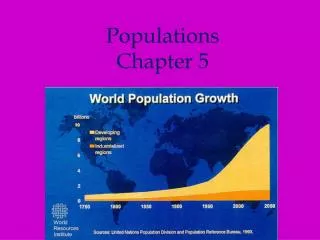
5.3 Human Population Growth • Historical Overview: Slow past growth w/limiting factors: scarce food/predators/disease=↑ death rate=multiple offspring w/few surviving • Exponential Human Population Growth • Industrial revolution improved nutrition/medicine = ↓ death rates w/birthrates remaining hi • The Prediction of Malthus • Exponential growth can’t last • Growth limited by competition-war; scarce resources-famine; parasitism-disease • Density Dependent Limiting Factors • World Population Growth Slows • Exponential Growth through mid-sixties; then slowed
Patterns of Human Population Growth • Demography: study of human growth (birth/death rates and age structure) • The Demographic Transition • Shift from High birth/death rates (Phase 1) to low birth/death rates (Phase 3) = U.S, Japan, Europe; J to S curve • Age Structure and Population Growth • A higher % of young people = growing population; equal age group # = slower, steady growth • Future Population Growth • Approx. 9 billion by 2050; but grow more slowly than last 50 years