Download

1 / 44
440 likes | 529 Views
The French Revolution was sparked by bad harvests, high prices, and high taxes that burdened the 3rd Estate, leading to questions raised by Enlightenment ideas. The unequal society, with the 1st and 2nd Estates having privileges, fueled discontent. Factors like economic troubles, debt, and weak leadership under Louis XVI contributed to the revolution. The Estates-General meeting in 1789 marked a turning point, leading to the formation of the National Assembly and key events such as the Storming of Bastille, the Great Fear, and the Declaration of the Rights of Man. The revolution saw the establishment of new government structures, conflicts with Europe, and the rise of political clubs like the Jacobins. The internal struggles culminated in the execution of Louis XVI and the radical changes in French governance.

E N D
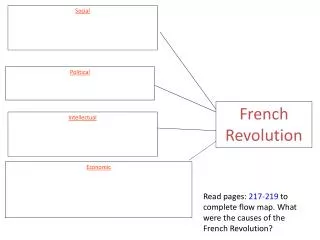
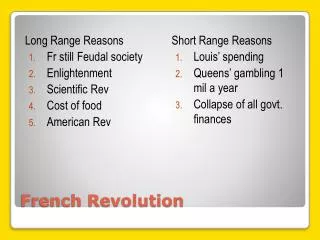
UNREST • Bad harvests • High prices • High taxes • Questions raised by the Enlightenment
Old Regime • 3Estates • 1st Estate • Catholic Church (clergy ) • 1% of population • 2nd Estate • Nobles • 2% of population
1st and 2nd Estates • Access to gov’t offices • Exempt from taxes • Rejected Enlightenment • Owned 30 % of land
3rd Estate • Everyone else • Bourgeoisie ( middle class ) • Bankers, factory owners, merchants • Well educated • Believed strongly in Enlightenment • Payed high taxes • Wealth ≠status and power
3rd Estate cont. • Workers • Poorest • Low wages • High unemployment • Peasants • Largest • Farmers • 80% of population • Paid ½ income to nobles, church, gov’t
Factors • New ideas about gov’t • Economic troubles • Debt • Louis XVI • Inherited • Backed American Revolution • Spent
Factors cont. • Weak leader – Louis XVI • Indecisive • Paid little attention to advisors • Queen interfered • Ignored problems
Estates-General • Louis XVI decides to try to tax 2nd Estate • Forced to call meeting of Estates-General • First in 175 years • May 5, 1789 Versailles
Estates General cont. • Each estate met separately to vote • Each estate had one vote • 1st and 2nd outvoted the 3rd
Estates General cont. • 3rd Estate wanted changes • All 3 meet together • Each delegate have a vote • Give advantage to 3rd • King denied • Leaders of 3rd called for National Assembly • Pass laws and reforms for people of France
National Assembly • June 17, 1789 voted to form National Assembly • Proclaimed end of monarchy • Representative gov’t • First deliberate act of revolution
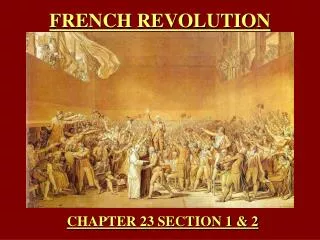
National Assembly • Locked out of meeting room • Broke into indoor tennis court • Tennis Court Oath • Pledge not to disband until new constitution is written • Joined by nobles and clergy in favor of reform • Louis XVI stationed military around Versailles
Storming of Bastille • Rumors spread • People began to arm themselves • July 14, 1789 stormed Bastille • Prison built in 1300 • In search of gunpowder • Mob overwhelmed guards • Symbolic act of revolt
Great Fear • Rebellion spread to countryside • Wave of panic • Peasants armed themselves • Broke in nobles homes • October 1789 • Angry women of Paris march on Versailles • Demand action to provide bread • Force Louis and Marie to return to Paris
The Rights of Man • By August 5th, Old Regime was dead • Commoners equal to nobles • Nat’l Assembly adopts statement of ideals • The Declaration of the Rights of Man and of the Citizen
Rights of Man • “Men are born free and remain free and equal in rights” • “Life, liberty, security, and resistance to oppression” • Equal justice • Freedom of speech and religion
The Church • Took over Church lands • Church officials and priests were to be elected an paid as gov’t officials • Many peasants alarmed • Opposed assembly’s reforms
June 1791 • Louis and Marie try to escape • Captured and returned to Paris
New Plan for Gov’t • September 1791 • New constitution • Creates limited monarchy • Creates new legislative body • Legislative Assembly • Power to create laws • Declare war
Divisions • Legislative Assembly split into 3 groups • To the left – RADICALS • Opposed monarchy; lots of change • In center – MODERATES • Some change • To the Right – CONSERVATIVES • Limited monarchy; few changes
War with Europe • Austria and Prussia urge for restoration of monarchy • April 1792 • Legislative Assembly declares war
War with Europe • Prussian forces advance quickly outside of Paris • Threaten to destroy Paris if royals harmed • August 10th • 20,000 men storm palace • Kill guards • Arrest Louis and family
Paris Commune • Paris radicals • More radical, more violent • Took king captive • Wanted universal male suffrage • Sans-culottes • Wanted greater changes • Discovered ways to exert power
September Massacres • Rumors that royal supporters would break out of prison and seize city • Citizens take law into own hands • Raid prison • Murder over 1000 prisoners
New Constitution • Legislative Assembly pressured • Set aside Constitution of 1791 • Deposes king • Dissolves assembly • Calls for election of new legislature
New Government • September 21 • National Convention takes office • Abolishes monarchy • Declares France a republic • Adult male citizens granted right to vote and hold office
Political Clubs • Girondins • Moderate • Represent areas outside of Paris • Feared radical mobs • The Mountain • Radicals of Paris • Jacobins
Jacobins • Jacobins – radical political organization takes charge • Jean-Paul Marot • Georges Danton • Tried Louis XVI for treason • Convicted • January 21, 1793 - beheaded
Problems Within • Many enemies within France • Peasant horrified by execution of king • Priests angered by gov’t control • Rival leaders stirring up rebellions in other provinces of France
Committee of Public Safety • To oversee war efforts created Committee of Public Safety • Maximillien Robespierre headed • Governed France as dictator • REIGN OF TERROR
Reign of Terror • Protect France from its enemies • Many fellow revolutionaries were sentenced to death • 1793 – 1794 • 45,000-55,000 people executed
Reign cont. • Revolutionary armies bring rebellious cities under control • Lyon – 1880 citizens executed • Nantes – sunk in barges • 85% from 3rd Estate • Violence was temporary Republic of Virtue
Republic of Virtue • Republic composed of good citizens • Good education – primary education for all • “citizen” replaced mister • Tried to control prices • Women attended National convention sessions • De-Christianization • Cult of the Supreme Being • Superstition rather than reason • New calendar (Sept 22, 1792)
End of Terror • June 1794 • Law of 22 Prairial • July 1794 • National Convention turns on Robespierre • July 28, 1794 • Robespierre is beheaded
New Government • Following terror moderate leaders draft new plan for gov’t (3rd since 1789) • Power with upper middle class • 2 house legislature • Executive body of 5 men (moderates) • Directory
Directory • Corrupt • Gave country period of order • Chose right general to lead army • Napoleon Bonaparte