Understanding Aerosols: Types, Sources, Measurement, and Their Impact on Air Quality**
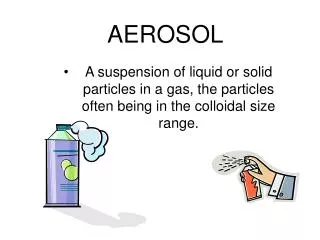
Aerosols are tiny particles suspended in the air, classified into types such as liquid, solid, dust, and smoke. Key sources include natural phenomena like dust and pollen, as well as human activities like combustion. Their sizes vary, influencing their behavior in the atmosphere. Measurement techniques include Total Suspended Particulate (TSP) and PM10 analysis, using filters and absorbance methods. Aerosols significantly impact air quality and health, evidenced by studies in polluted urban areas. Understanding their nature and measurement is crucial for environmental monitoring.

Understanding Aerosols: Types, Sources, Measurement, and Their Impact on Air Quality**
E N D
Presentation Transcript
AEROSOLS: types • LIQUIID • SOLID • Dust • Smoke • Fly ash • pollen • Cloud • Mist • Fog • smog
AEROSOLS: sources DUST SEA • Dust • Smoke • Fly ash • pollen • plant fragments • cement • brake lining • tires • soil chemical concentration factor (surface effects) CCF = [aerosol]/[sea]
AEROSOLS: sizes • > 400 nm scatter light • < 0.01 micron coagulate • > 10 micron settle out • Typical size: 0.1-1 micron
AEROSOLS: how to measure them • Alphabet soup: • COH • TSP • IP • TDF • PM10 • light scattering • collecting on filters
AEROSOLS: how to measure them • Alphabet soup: • COH • TSP • IP • TDF • PM10 Coefficient of Haze Draw 300 meters through a filter measure absorbance x 100 >6 bad for asthma typical samples 5-10 micron
AEROSOLS: how to measure them • Alphabet soup: • COH • TSP • IP • TDF • PM10 Total Suspended Particulate Weighing after filtering Units: μg/m3 “normal” ~ 10 μg/m3 sometimes 500 μg/m3 in cities
AEROSOLS: how to measure them • Alphabet soup: • COH • TSP • IP • TDF • PM10 Inhalable Particulates Generally IP ~ 0.45 TSP
AEROSOLS: how to measure them • Alphabet soup: • COH • TSP • IP • TDF • PM10 Total Dust Fall units: g m-2 month-1 should be < 7 g m-2 month-1 often exceeded in industrial areas
AEROSOLS: how to measure them • Alphabet soup: • COH • TSP • IP • TDF • PM10 Particulate matter < 10 micron PM10 = TSP < 10 μ
50% (by mass) of a set of particles are less then 10 micron and 50% are between 10 and 20 micron. PM10 is what percentage of PM20? [A] 0.1 % [B] 10 % [C] 16 % [D] 50 % [E] 95 %
50% (by mass) of a set of particles are 10 micron and 50% are 20 micron. All particles larger than 10 micron are filtered out. How much does the total number of particles go down? [A] by 50% [B] by less than 50% [C] by more than 50% [D] It depends on the type of particle
10% (by mass) of a set of particles are 10 micron and 50% are 20 micron. All particles larger than 10 micron are filtered out. How much does the total surface area go down? [A] by 50% [B] by less than 50% [C] by more than 50% [D] It depends on the type of particle
Wet deposition dry deposition coagulation
Combustion Products. Fly-ash vs. bottom-ash 150 PAHs With 2 – 7 rings
Particulate air quality in major world cities. Values are annual PM10 means. Horizontal line is WHO air quality guideline