Introduction to Uniform Circular Motion
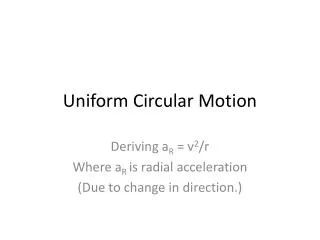
Introduction to Uniform Circular Motion. Derivation. There is slightly different from the derivation found in the text. For uniform linear motion we can find position by: When we have uniform circular motion, however, we can use. When given a circle: Where R is given as the radius (r).

Introduction to Uniform Circular Motion
E N D
Presentation Transcript
Derivation • There is slightly different from the derivation found in the text. • For uniform linear motion we can find positionby: When we have uniform circular motion, however, we can use
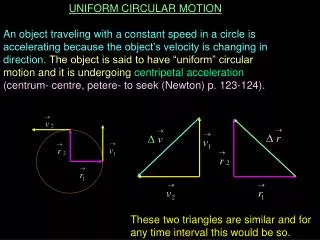
When given a circle: Where R is given as the radius (r). We know that: You can then take the derivative of the position in respect to time: and You can then take the derivative a second time: and
R-Form • 2 • , These are the MAGNITUDES of the acceleration, velocity and position vectors
Acceleration (Derivation) • Follow same pathway as with velocity, just use the second derivative taken.
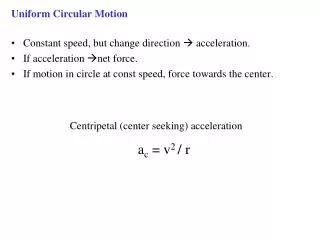
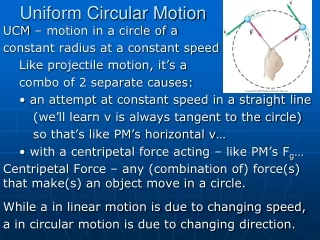
Some Conclusions to be made: • Overall: Fundamental equation of circular motion
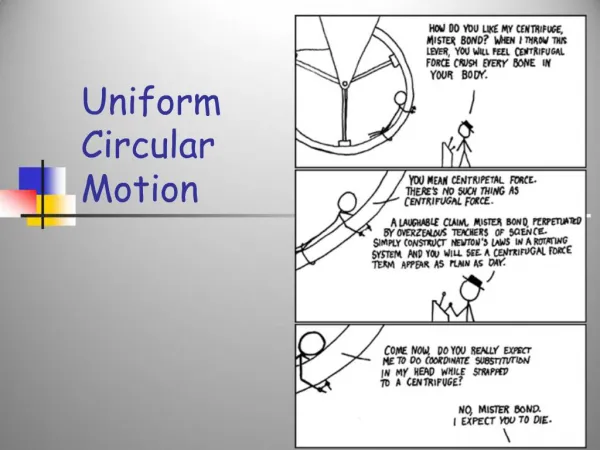
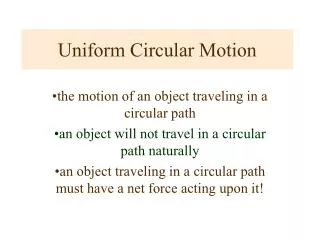
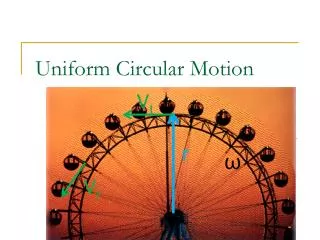
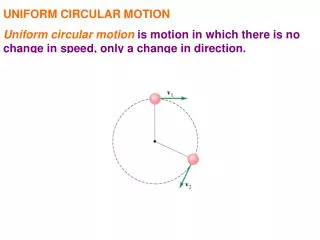
Centripetal vs. Centrifugal • Acceleration is always to the center • It is perpendicular to the motion • When this is happening, this is uniform circular motion • CENTRIPETAL MOTION/FORCE • The opposite: centrifugal