Understanding Uniform Circular Motion and Related Forces
This guide explores the concept of uniform circular motion where an object moves in a circular path at constant speed. It discusses centripetal force, the net force directing an object toward the center of a circle, calculated as Fc = mv²/r, and how it relates to centripetal acceleration, Ac = v²/r. The guide also clarifies the misconception of centrifugal force as a fictitious force resulting from inertia. A practical example involving Tarzan swinging on a vine is included to illustrate force diagrams, centripetal force, tension, and centripetal acceleration.

Understanding Uniform Circular Motion and Related Forces
E N D
Presentation Transcript
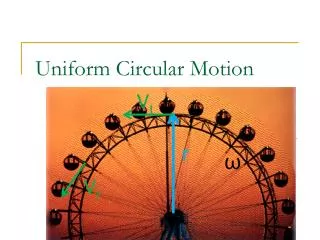
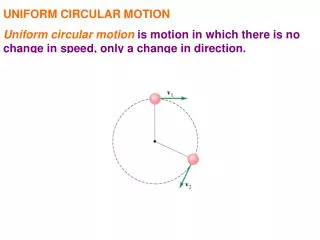
Uniform Circular Motion • Uniform Circular Motion – a motion in which an object moves in a circular path at constant speed • V = 2πr/T
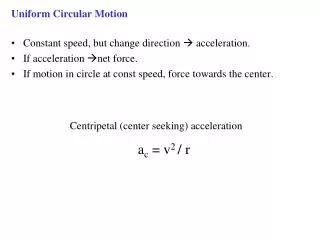
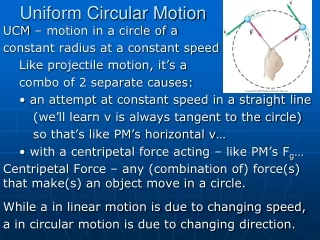
Centripetal Force • Centripetal Force- The net force causing an object to take a circular path. Directed toward the center of the circle. “Center Seeking” Fc = mv2/r • Note: this is not a classification of a new force this is a net force that can be attributed to by other forces.
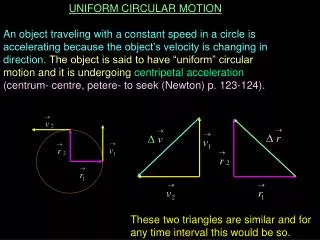
Centripetal Acceleration Applying F=ma We get F/m = a = mv2/r/m or v2/r Ac = v2/r This is centripetal acceleration. Fc Ac
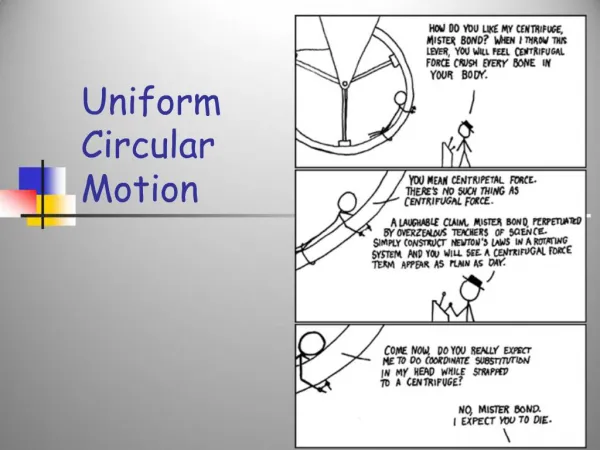
Centrifugal Force • Centrifugal Force- A fictitious (false) force that is said be applied radially outward. “Center Fleeing” Can be attributed to Inertia.
Example • Tarzan, mass 65 kg, is swinging on a 2.5 m long vine. He is moving at 4.0 m/s at the bottom of his swing. • a) Draw a force diagram at the bottom of Tarzan’s swing. • b) Find the centripetal force at the bottom of Tarzan’s swing. • c) Find the force of tension at the bottom of Tarzan’s swing. • d) Find the centripetal acceleration.