Understanding Energy and Its Transformations
320 likes | 430 Views
Learn about the types of energy, laws of thermodynamics, energy conversions, and how energy is transferred and transformed in various forms. Explore examples of potential and kinetic energy, as well as essential concepts like entropy in this educational guide.


Understanding Energy and Its Transformations
E N D
Presentation Transcript
ENERGY • THE ABILITY TO DO WORK OR TRANSFER HEAT.
WORK • THE ENERGY TRANSFERRED BY A FORCE TO MOVE AN OBJECT Formula for Work: WORK = FORCE X DISTANCE
WORK • WORK IS DONE ON AN OBJECT WHEN AN OBJECT IS FORCED TO MOVE Dodge.com
TYPES OF ENERGY • POTENTIAL • KINETIC
POTENTIAL ENERGY • STORED ENERGY • ENERGY AT REST • NOT DOING WORK OR TRANSFERRING HEAT
POTENTIAL ENERGY gaspumpheaven.com
KINETIC ENERGY • ENERGY IN MOTION • ENERGY IN USE
KINETIC ENERGY Coloradorunner.com FreeFoto.com FreeFoto.com
Swing Physics- video • http://www.youtube.com/watch?v=-a3F7oaRJOw
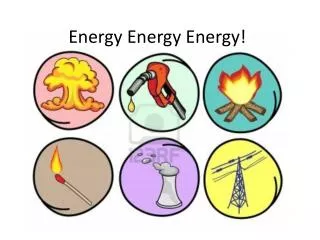
FORMS OF ENERGY • CHEMICAL • ELECTRICAL • MECHANICAL • SOUND (Included in mechanical) • HEAT (THERMAL) • LIGHT (RADIANT) • NUCLEAR
CHEMICAL • The potential energy stored in chemical bonds that hold chemical compounds together • Released during chemical reactions FreeFoto.com
ELECTRICAL ENERGY • The energy associated with moving electric charges FreeFoto.com
MECHANICAL ENERGY • The energy associated with the motion or position of an object • Moving parts, muscles FreeFoto.com
SOUND ENERGY FreeFoto.com
HEAT (THERMAL) ENERGY • The total energy of the particles in an object • Temperature of object • Boiling water > ice FreeFoto.com
LIGHT (RADIANT) ENERGY • The energy associated with waves of light FreeFoto.com FreeFoto.com
NUCLEAR ENERGY • The potential energy associated with the nucleus of an atom • Fission - Splitting (Uranium) • Fusion - Combining (H->He) http://iter.rma.ac.be/en/img/FusionReaction.jpg
FIRST LAW OF THERMODYNAMICS • Energy cannot be created nor destroyed, it can only change form. • Burn wood Chemical energy changes into light and heat • Eat cheeseburger Chemical energy changes into mechanical and heat
SECOND LAW OF THERMODYNAMICS • When energy is changed from one form to another, some energy is always lost as heat. 100% of energy cannot be converted into useful work • ENERGY CONVERSIONS ARE NOT 100% EFFICIENT.
FOOD CHAIN • 90% OF THE ENERGY IS LOST AS HEAT AT EACH STEP OF A FOOD CHAIN http://lgfl.skoool.co.uk/uploadedImages/12.2_energy_food_chains.gif
ENTROPY • THE THERMODYNAMIC MEASURE OF DISORDER • A SYSTEM TENDS TO BECOME DISORDERLY • TO MAINTAIN ORDER ENERGY MUST BE USED
ENTROPY www.dodge.com • TO KEEP YOUR ROOM CLEAN YOU MUST USE ENERGY TO PICK UP AND ORGANIZE • TO MAINTAIN A CAR THE OIL MUST BE CHANGED, TUNE UPS, SPARK PLUGS REPLACED, FLUIDS TOPPED OFF OR REPLACED, ETC.
PROFESSOR WALTER LEWIN’S PENDULUM • http://www.youtube.com/watch?v=mhIOylZMg6Q • Bowling ball pendulum: • http://www.youtube.com/watch?v=i2GdY1OlDpA
Newton's cradle • http://www.youtube.com/watch?v=0LnbyjOyEQ8
MYTH BUSTERS NEWTON’S CRADLE • http://www.youtube.com/watch?NR=1&v=BiLq5Gnpo8Q&feature=endscreen • http://www.youtube.com/watch?v=OuA-znVMY3I
Energy Conversions • An energy conversion is a change from one form of energy to another. • Any form of energy can change into any other form of energy. • In the picture on the next slide we see potential energy transforming into kinetic energy and vice versa
Conversions Involving Chemical Energy • The chemical energy in the food you eat is converted into another kind of chemical energy your body can use (ATP). • Your body then converts that chemical energy into kinetic energy when you move.
Conversions Involving Electricity • You encounter many electrical energy conversions in your day to day life.
Where Does the Energy Go? • The 1st Law of Thermodynamics states that energy cannot be created or destroyed. • Energy can be converted from one form of energy to another, but all the different forms of energy in a closed system will always add up to the same amount of total energy.
No Conversion Without Thermal Energy • Any time one form of energy is converted into another, some of the original energy always gets converted into thermal energy. • The thermal energy due to friction that results from energy conversions is usually not useful energy.