TONGUE COMPUTING SYSTEM
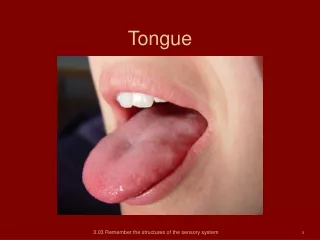
The Tongue Computing System (TCS) represents a breakthrough in assistive technology, designed for individuals with disabilities to enhance their interaction with their environment. Also known as the Tongue Drive System, this interface employs a permanent magnet on the tongue and magnetic sensors worn as a headset to enable users to control devices, including wheelchairs and computers, with tongue movements. Future applications may extend to controlling robotic arms for daily tasks, improving the quality of life for users. Laboratory trials demonstrate its potential, with further clinical tests needed for practical use.

TONGUE COMPUTING SYSTEM
E N D
Presentation Transcript
TONGUE COMPUTING SYSTEM BY N PAVAN KUMAR (07J11A0436)
INTRODUCTION :- • This technology is new inductive tongue-computer interface to be used for the disabled people for environmental control. • This technology is also called as “TONGUE DRIVE SYSTEM”
PARTS OF TONGUE COMPUTING :- • Permanent magnet • Magnetic sensors • Control unit • External receiver
IMPLANTATION :- • Permanent magnet placed on the tongue • Magnetic sensors wore as a head set • Wireless t transceiver connected to the headset and wore to head
Operation of Tongue computing ( TDS) :-
Applications :- • A disabled person can drive a wheel chair. • Can operate a computer in which the person can type words, play games. • Manipulation of a mobile device through an assistive tongue computing.
Future of TCS :- • To control a robotic arm to use it to eat, drink, hold any thing and use it as a natural arm. • To use in everyday purpose and to control the activities going on around without any difficulties.
Conclusion:- • The operating principle and set up of such a novel passive tongue HCI has been established with successful laboratory trials & experiments • Further clinical trials will be required to test out the devices on disabled persons before it is ready for future commercial development
Result :- • The device is able to perform two main pc functions that of the keyboard and mouse. • The results show that this device allows the severely disabled person to have some control in his environment such as to turn on/off or control daily electrical appliances. • Also can be used as a viable pc human computer interface (HCI)by tongue control.
References :- • C Lau and S O´Leary, ”Comparison of Computer Interface Devices for Persons with Severe Physical • Disabilities”, The American Journal of Occupational Theraphy, vol. 47, pp.1022-1030, 1993 • C Clayton, R G S Platts, M Steinberg and J R Hennequin, “Palatal tongue controller”, J. of Microcomputer • Buchhold N, “Apparatus for controlling peripheral devices through tongue movement, and method of • processing control signals” ,United States Patent no. 5,460,186, 1995. • E Müller, et al. ”Perioral tissue mechanics during speech production”. In J. Eisenfeld & C. DeLisi (Eds.)