Exploring Optimal Strategies in Extended Factor Games and Number Classifications
This lesson delves into an extended factor game board and analyzes optimal first moves, focusing on the significance of numbers in scoring strategies. Students explore the best and worst moves, examine division of 84 by both 14 and 15, and what insights these calculations reveal about the numbers. The activity encourages critical thinking about prime numbers and their effectiveness in the game. Additionally, students classify numbers from 2 to 30 based on their proper factors, learning about abundant, deficient, and perfect numbers. The assignment concludes with a reflective question on why 24 is used to divide the day into hours.

Exploring Optimal Strategies in Extended Factor Games and Number Classifications
E N D
Presentation Transcript
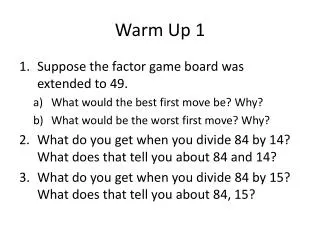
Warm Up 1 • Suppose the factor game board was extended to 49. • What would the best first move be? Why? • What would be the worst first move? Why? • What do you get when you divide 84 by 14? What does that tell you about 84 and 14? • What do you get when you divide 84 by 15? What does that tell you about 84, 15?
Using Your Analysis of First Moves • List all the numbers that allow your opponent to score only one point. What are these numbers called? Why?
Using Your Analysis of First Moves • List all the numbers that allow your opponent to score only one point. What are these numbers called? Why? • Are primes good first moves? (a good move is where the picker scores more than the other player? • Which number would make you lose your first turn? Why?
Using Your Analysis of First Moves • List the moves allow your opponent to score more than one point. • What are these numbers called?
Using Your Analysis of First Moves Ancient mathematicians used the sum of the proper factors to classify numbers as abundant, deficient and perfect. Draw and label 3 circles as below. Use your list of first moves (it includes the sums of proper factors) to place the numbers 2 to 30 correctly. A sample for each is done for you. 12 15 6 Abundant Deficient Perfect
Using Your Analysis of First Moves • On your vocabulary sheet, write a definition for abundant, deficient, or perfect numbers.
Using Your Analysis of First Moves Write the question and a complete answer in sentences on lined paper. When finished store your answer in the journal section of your binder. • Long ago the people observed the rising and setting of the sun. They decided the time between two sunrises would be one day. They divided the day into 24 hours. Use your knowledge of factors to answer: • Why is 24 a more convenient choice than 23 or 25 for the hours in a day? • If you were select a different number to represent the hours in a day, what number would you choose. Why?