Understanding Semicolons, Colons, and Apostrophes in English Grammar
Mastering the use of semicolons, colons, and apostrophes is essential for clear and effective writing. Semicolons can link closely related independent clauses or separate complex lists. Colons introduce lists and emphasize important points. Apostrophes denote possession and clarify ownership. This guide provides examples and practices for using these punctuation marks correctly in various contexts, ensuring your writing remains precise and impactful.

Understanding Semicolons, Colons, and Apostrophes in English Grammar
E N D
Presentation Transcript
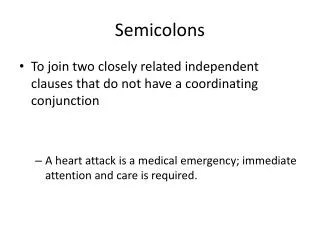
Semicolons • To join two closely related independent clauses that do not have a coordinating conjunction • A heart attack is a medical emergency; immediate attention and care is required.
Practice • Kyle Maynard has a rare disorder called “congenital amputation”; he has been limbless since birth. • The semicolon is separating two independent clauses.
Practice • Kyle has traveled cross-country as a motivational speaker; won an ESPN ESPY Award, a Courage Award, and wrestling awards and modeled for Vanity Fair and Abercrombie & Fitch. • The semicolon is breaking up a lengthy sentence.
Colons • After a salutation in a business letter • Dear Judge Parker: • Dear Governor Whitman: Between the hours, minutes, and seconds of a number indicating time 8:30 p.m. 9:45 a.m. 10:24:55
Colons: Practice • Whether it’s 12:00 midnight, 12:00 noon, or any hour between, the Orloj will astound you with its moving statues.
Colons • Use a colon to emphasize a word, phrase, clause or sentence that explains or adds impact to the main clause. • The newest candidates announced their platforms today: Lower taxes and more efficient services are the consistent themes.
Colons • To introduce a list • I got all the proper equipment: scissors, a bucket of water to keep things clean, some cotton for the stuffing, and needle and thread to sew it up.
Semicolons • Before a conjunctive adverb (with a comma after) when the word connects two independent clauses in a compound sentence • I know that I need to finish the research for my essay; however, our Internet service is down and the library is closed on Sunday.
Semicolons • To separate groups of words that already contain commas • Every Saturday night my little brother gathers up his things-goggles, shower cap, and snorkel; bubble bath, soap, and shampoo; tapes, stereo, and rubber duck- and heads for the tub.
Apostrophes • For some, a mountain’s icy walls or frozen waterfalls are a real test. • Shows possession
Apostrophes • A climber’s tools include crampons, hard boots, an ice pick, ice screws, cold-weather clothes and goggles. • Shows possession
Apostrophes Girl’s guitar (one girl) Girls’ guitar (two girls)
Apostrophes Boss’s order (one boss) Bosses’ order (two bosses)
Apostrophes • Hoshi, Linda, and Nakiva’s water skis • All three own one pair of skis • Hoshi’s, Linda’s, and Nakiva’s water skis • Each person owns their own set of skis