Chap 4 Laplace Transform
Chap 4 Laplace Transform . 中華大學 資訊工程系 Fall 2002. Outline. Basic Concepts Laplace Transform Definition, Theorems, Formula Inverse Laplace Transform Definition, Theorems, Formula Solving Differential Equation Solving Integral Equation. Basic Concepts. 微分方程式. 代數方程式. Laplace Transform.

Chap 4 Laplace Transform
E N D
Presentation Transcript
Chap 4 Laplace Transform 中華大學 資訊工程系 Fall 2002
Outline • Basic Concepts • Laplace Transform • Definition, Theorems, Formula • Inverse Laplace Transform • Definition, Theorems, Formula • Solving Differential Equation • Solving Integral Equation
Basic Concepts 微分方程式 代數方程式 Laplace Transform Differential Equation f(t) L{ f(t)} = F(s) Algebra Equation F(s) Inverse Laplace Transform Solution of Differential Equation f(t) L-1{F(s)} = f(t) Solution of Algebra Equation F(s)
Basic Concepts Laplace Transform L{ f(t)} = F(s) Inverse Laplace Transform L-1{F(s)} = f(t)
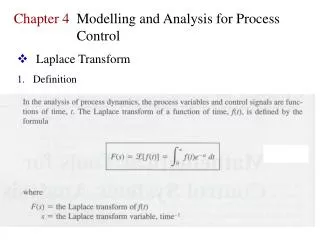
Laplace Transform • Definition The Laplace transform of a function f(t) is defined as • Converges: L{f(t)} exists • Diverges: L{f(t)} does not exist
Laplace Transform s=0.125 e-st s=0.25 s=0.5 s=1 s=2 s=4 s=8 t
Laplace Transform • Example : Find L{ 1} Sol:
Laplace Transform • Example : Find L{ eat } Sol:
Laplace Transform • Example 4-2 : Find L{ tt } Sol: L{ tt } does not exist
Laplace Transform • Exercise 4-1 : • Find • Find • Find • Find
Laplace Transform • Theorems Definition of Laplace Transform Linear Property Derivatives Integrals First Shifting Property Second Shifting Property
Laplace Transform • Theorems Change of Scale Property Multiplication by tn Division by t Unit Impulse Function Periodic Function Convolution Theorem
First Shifting Theorem • If f(t) has the transform F(s) (where s > k), then eatf(t) has the transform F(s-a), (where s-a > k), in formulas, or, if we take the inverse on both sides
Excises sec 5.1 • #1, #7, #19, #24, #29,#35, #37,#39
Laplace of Transform the Derivative of f(t) • Prove Proof:
Examples • Example 1: Let f(t)=t2, Derive L(f) from L(1) • Example 2: Derive the Laplace transform of cos wt
Differential Equations, Initial Value Problem • How to use Laplace transform and Laplace inverse to solve the differential equations with given initial values
Example : Explanation of the Basic Concept • Examples
Laplace Transform of the Integral of a Function • Theorem : Integration of f(t) Let F(s) be the Laplace transform of f(t). If f(t) is piecewise continuous and satisfies an inequality of the form (2), Sec. 5.1 , then or, if we take the inverse transform on both sides of above form
An Application of Integral Theorem • Examples
Laplace Transform • Unit Step Function (also called Heaviside’s Function)
Second Shifting Theorem; t-shifting • IF f(t) has the transform F(s), then the “shifted function” has the transform e-asF(s). That is
The Proof of the T-shifting Theorem • Prove Proof:
Application of Unit Step Functions • Note • Find the transform of the function
Example : Find the inverse Laplace transform f(t) of
Area = 1 Short Impulses. Dirac’s Delta Function
Area = 1 Laplace Transform • Unit Impulse Function (also called Dirac Delta Function)
Laplace Transform • Example 4-6 : Prove Proof
Homework • section 5-2 #4, #7, #9, #18, #19 • Section 5-3 #3, #6, #17, #28, #29
Differentiation and Integration of Transforms • Differentiation of transforms
Example Find the inverse transform of the function
Convolution. Integration Equation • Convolution • Properties
Example1 Using the convolution, find the inverse h(t) of • Example 2 • Example 3
Laplace Transform • Example 4-7 : Prove Proof:
Integration Equations • Example
Homeworks • Section 5-4 • #1,#13 • Section 5-5 • #7, #14, #27
Laplace Transform • Formula
Laplace Transform • Formula
Inverse Laplace Transform • Definition The Inverse Laplace Transform of a function F(s) is defined as
Inverse Laplace Transform • Theorems Inverse Laplace Transform Linear Property Derivatives Integrals First Shifting Property Second Shifting Property
Inverse Laplace Transform • Theorems Change of Scale Property Multiplication by tn Division by t Unit Impulse Function Unit Step Function Convolution Theorem