Download
1 / 20
200 likes | 322 Views
This comprehensive guide covers the fundamentals of exponents, including their notation, interpretation, and the role they play in mathematical expressions. Learn how to read exponents such as "three to the fourth power" and "three squared," and discover how to multiply out exponents step-by-step. The document also emphasizes the importance of the order of operations (PEMDAS) when handling complex calculations. Challenge yourself with practice problems to reinforce your understanding, and acquire essential skills for tackling math effectively.

E N D
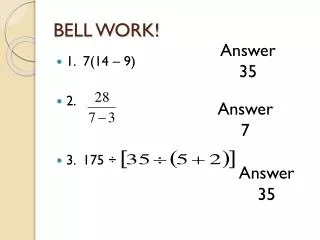
BELL WORK! Answer35 • 1. 7(14 – 9) • 2. • 3. 175 ÷ Answer7 Answer35
Order of Operations with exponents
Location of Exponent • An exponent is a little number high and to the right of a base number. Exponent 3 4 Base
What an Exponent Represents • An exponent tells how many times a number is multiplied by itself. 4 = 3 x 3 x 3 x 3 3
How to read an Exponent • This exponent is read three to the fourth power. Exponent 3 4 Base
How to read an Exponent • This exponent is read three to the 2nd power or three squared. Exponent 3 2 Base
How to read an Exponent • This exponent is read three to the 3rd power or three cubed. Exponent 3 3 Base
Read These Exponents 9 2 6 7 2 3 5 4
What is the Exponent? 3 2 x 2 x 2 = 2
What is the Exponent? 4 5 x 5 x 5 x 5 = 5
How to Multiply Out an Exponent 4 3 = 3 x 3 x 3 x 3 9 27 81
You Try: 3 5 125 =
PEMDAS 3 (9+1) + 62 3(10)+62 3(10)+36 30+36 66
PEMDAS 3+23- (9+1) 3+23- 10 3+8-10 11-10 1
PEMDAS 4+ 10 x 23 -16 4+10 x 8 -16 4+ 80 -16 84-16 68
PEMDAS 21 + 102 10 21+10010 21 + 10 31
PEMDAS 10+72-2 x 5 10+49–2 x 5 10+49- 10 59 - 10 49
Challenge!!20 - 3 • 6 + 102 + (6 + 1) • 4 = 20 - 3 • 6 + 102 + (7) • 4 (parentheses) = 20 - 3 • 6 + 100 + (7) • 4 (exponents) = 20 - 18 + 100 + (7) • 4 (Multiply l/r.) = 20 - 18 + 100 + 28 (Multiply l/r.) = 2 + 100 + 28 (Subtract l/r.) = 102 + 28 (Add l/r.) =130 (Add.)
Skills Check! When you finish turn your paper over and put it in the corner of your desk. Silent read, work on other homework or practice more problems. No talking. Practice: Blue Book Pages 20-21 #’s 1-23