Understanding Depression: Biological and Neuropharmacological Perspectives
40 likes | 147 Views
This comprehensive overview explores depression from a biological standpoint, discussing its classification into reactive and endogenous types. Heredity plays a significant role, with monozygotic twins having a 70% concordance rate. Key neuroanatomical findings highlight the involvement of the amygdala, prefrontal cortex, and anterior cingulate cortex. The monoamine hypothesis and receptor regulation theories are highlighted, along with effective antidepressants including MAOIs, tricyclics, and SSRIs like Prozac. The text also addresses circadian rhythms and neurotrophic factors in depression's complexity.


Understanding Depression: Biological and Neuropharmacological Perspectives
E N D
Presentation Transcript
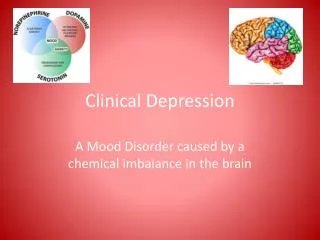
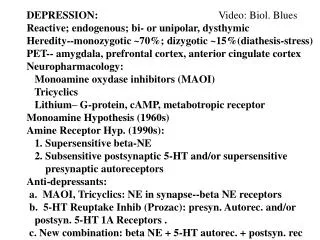
DEPRESSION: Video: Biol. Blues Reactive; endogenous; bi- or unipolar, dysthymic Heredity--monozygotic ~70%; dizygotic ~15%(diathesis-stress) PET-- amygdala, prefrontal cortex, anterior cingulate cortex Neuropharmacology: Monoamine oxydase inhibitors (MAOI) Tricyclics Lithium– G-protein, cAMP, metabotropic receptor Monoamine Hypothesis (1960s) Amine Receptor Hyp. (1990s): 1. Supersensitive beta-NE 2. Subsensitive postsynaptic 5-HT and/or supersensitive presynaptic autoreceptors Anti-depressants: a. MAOI, Tricyclics: NE in synapse--beta NE receptors b. 5-HT Reuptake Inhib (Prozac): presyn. Autorec. and/or postsyn. 5-HT 1A Receptors . c. New combination: beta NE + 5-HT autorec. + postsyn. rec
5-HT Reuptake Inhib. (SSRI, eg., Prozac): 1. 5-HT in synapse up 2. Down-regulate presynaptic autoreceptors -- negative feedback down -- presynaptic release of 5-HT up 3. Synaptic 5-HT up -- a. reuptake block (Prozac) -- b. presynaptic release up -- stimulation of subsensitive postsynaptic 5-HT-1A ‘normalized’ (PET: 5-HT 1A reduced in raphe n. and cingulate).
RECEPTOR REGULATION UP NORMAL DOWN
Circadian rhythms: REM, SWS, ECT PET: amygdala, prefrontal cortex, anterior cingulate cortex Volume: amygdala larger, hippocampus smaller Neurotrophic Factors rumination oxytocin