1 / 7

Understanding Metal and Anion Formulas: Cation Charges, Polyatomics, and Naming Conventions

This guide provides clear instructions on how to write chemical formulas for compounds involving metals (cations) and anions. Begin with the cation, represented with a Roman numeral to indicate charge if applicable, followed by the anion. For anions ending in "-ide", refer to the periodic table for their names. Use the "criss-cross" method to derive subscripts based on charge balance. Special attention is given to polyatomic ions and how to properly format them in chemical formulas. Simplify the resulting formula by reducing subscripts.

juana
Download Presentation

Understanding Metal and Anion Formulas: Cation Charges, Polyatomics, and Naming Conventions

An Image/Link below is provided (as is) to download presentation Download Policy: Content on the Website is provided to you AS IS for your information and personal use and may not be sold / licensed / shared on other websites without getting consent from its author. Content is provided to you AS IS for your information and personal use only. Download presentation by click this link. While downloading, if for some reason you are not able to download a presentation, the publisher may have deleted the file from their server. During download, if you can't get a presentation, the file might be deleted by the publisher.

E N D

Presentation Transcript


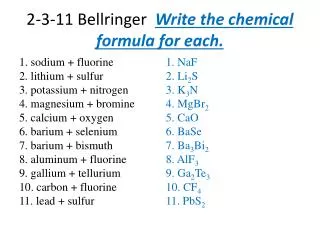
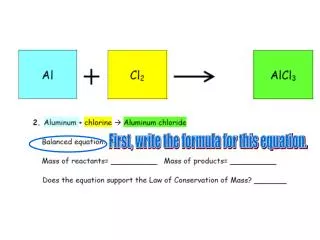
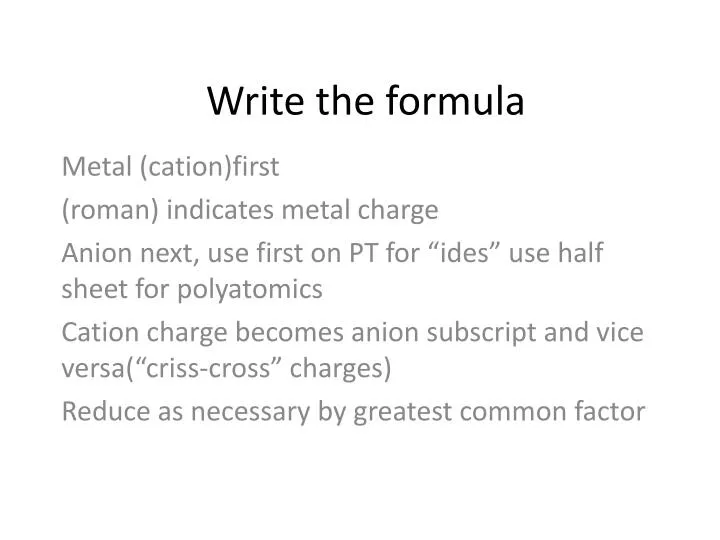
  1. Write the formula Metal (cation)first (roman) indicates metal charge Anion next, use first on PT for “ides” use half sheet for polyatomics Cation charge becomes anion subscript and vice versa(“criss-cross” charges) Reduce as necessary by greatest common factor

  2. Sodium Chloride Na+ Cl- NaCl

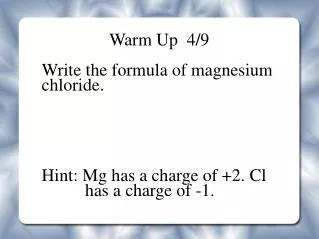
  3. Magnesium fluoride Mg2+ F- MgF2

  4. calcium hydroxide Ca2+ OH- Ca(OH)2

  5. Name a formula Metal (cation)first, just the name no prefix, no suffix IFF!!! PT shows more than one charge for the metal, Use (roman) to indicate metal charge Cation charge = (anion charge)X(anion subscript)/(cation subscript) Anion name next

  6. Fe3(PO4)2 Iron Iron ( ) Iron ( ) Phosphate (3)x(2)/3=2 Iron (II) Phosphate +2 +3 Fe There’s two oxidation states, so we’ll need roman numerals. Anion subscript is 2 Anion charge is 3- Cation subscript is 3 Roman = 2

  7. Parenthesis • Use around polyatomics when there’s more than one in the molecule!
More Related