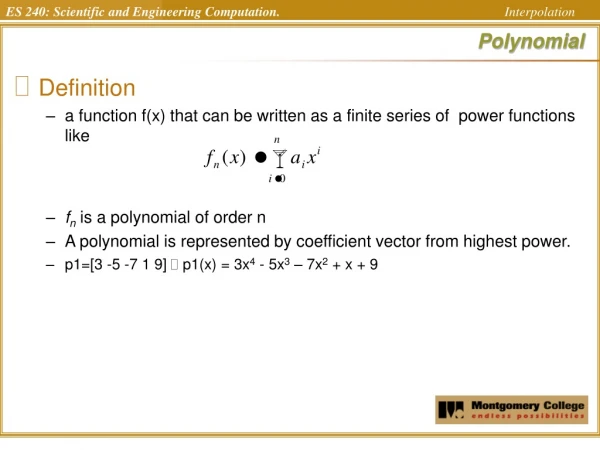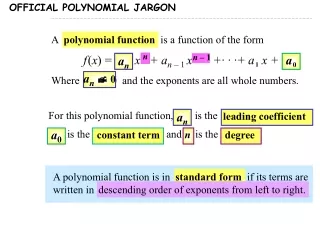
Comprehensive Guide to Polynomial Functions
Learn all about polynomial functions, from lead degree and coefficients to zeros and asymtotes. Master concepts like quadratic and linear functions with detailed explanations and examples.

Comprehensive Guide to Polynomial Functions
E N D
Presentation Transcript
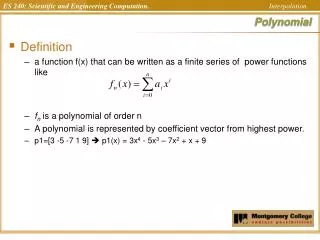
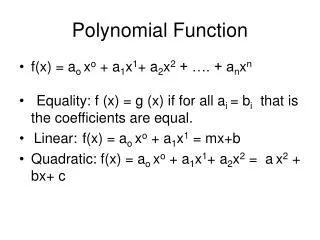
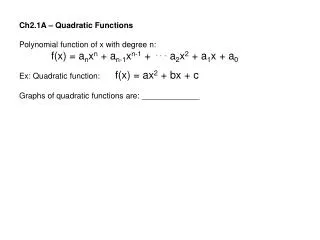
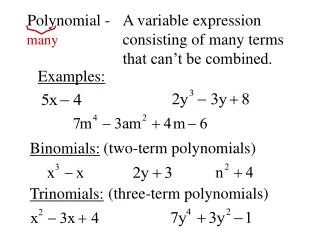
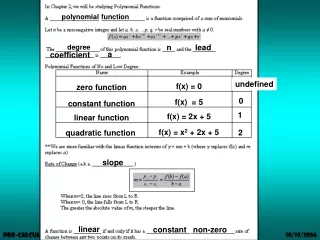
polynomial function n lead degree a coefficient undefined f(x) = 0 zero function 0 f(x) = 5 constant function 1 f(x) = 2x + 5 linear function f(x) = x2 + 2x + 5 2 quadratic function slope linear constant non-zero
roots or solutions x = -1 or 3.5 vertex: (h, k) complete the square vertex: (–4, –1) axis of symmetry: x = –4
vertex: (1, 5) vertex: x – intercepts:
constants constant of variation or proportion power is proportional to varies as power function power: –4 constant of variation: 2 not a power function: power isn’t a constant power function independent variable: r power: 2 constant of variation: power is 1, constant of variation is 2 power is 2, constant of variation is 1 direct variation
d = k F d = k t 2 non-negative integer monomial degree: 0 lead coefficient: 4 not monomial power is ½ (not an integer) monomial degree: 3 lead coefficient: 13 not monomial power is a variable
vertical stretch / shrink vertical stretch / shrink reflection across the x-axis domain range continuity increasing decreasing symmetry boundedness extrema asymptotes end behavior
divisor dividend quotient remainder
(3)2 – 4(3) – 5 = 9 – 12 – 5 = –8 k = 3 (–2)2 – 4(–2) – 5 = 4 + 8 – 5 = 7 k = –2 (5)2 – 4(5) – 5 = 25 – 20 – 5 = 0 k = 5 divides evenly zero x - intercept solution root
so factors are: x + 4, x – 3, x + 1 3(x + 4)(x – 3)(x + 1) = 3x3 + 6x2 – 33x – 36 so factors are: x + 3, x + 2, x – 5 2(x + 3)(x + 2)(x – 5) = 2x3 – 38x – 60
f(x) = x2 – 16 (x + 4)(x – 4) = 0 x = 4, x = –4 rational zeros
Use the rational zeros theorem to find the rational zeros of f(x) = 2x3 + 3x2 – 8x + 3 p = integer factors of the constant q = integer factors of the lead coefficient potential:
complex (real and non-real) zeros * non-real zeros are not x – intercepts zeros: 3i, – 3i, – 5 x-intercepts: – 5 complex conjugate (a + bi and a – bi)
denominator the x – axis ( y = 0 ) the line y = an / bm there is no quotient output input
vertical asymptote: x – intercept none none y – intercept horizontal asymptote: y = 0 (0, 4) vertical asymptote: x – intercept x = –1 (0, 0) (1, 0) y – intercept horizontal asymptote: none (0, 0) slant asymptote: y = x – 2
(–3, 4) U (4, ) [ –3, ) (– , –3) (– , –3) because the graph crosses the x-axis because the graph does not cross the x-axis
–3 1 2 1, –3, 2 + – + + (– , –3) U (1, 2) U (2, ) (–3, 1)
Write a standard form polynomial function of degree 4 whose zeros include 1 + 2i and 3 – i. quiz
Solve the following inequality using a sign chart: x3 + 2x2 – 11x – 12 < 0 quiz
zeros: x – intercepts: Write the following polynomial function in standard form. Then identify the zeros and the x – intercepts. f(x) = (x – 3i) (x + 3i) (x + 4) quiz
a.) 2, –1 , –6 b.) (–6, –1) U (2, ) c.) (–, –6) U (-1, 2) • Without graphing, using a sign chart, find the values of x that cause f(x) = (x – 2) (x + 6) (x + 1) to be: • a.) zero ( f(x) = 0 ) • b.) positive ( f(x) > 0 ) • c.) negative ( f(x) < 0 ) quiz
Use the quadratic equation to find the zeros of f(x) = 5x2 – 2x + 5. Your answer must be in exact simplified form. quiz
Find all zeros of f(x) = x4 + 3x3 – 5x2 – 21x + 22 and write f(x) in its linear factorization form
2i is a zero of f(x) = 2x4 – x3 + 7x2 – 4x – 4. Find all remaining zeros and write f(x) in its linear factorization form. quiz