Advancements in Perennial Grains: Enhancing Soil Health and Agricultural Sustainability
This document explores the development of perennial grains, focusing on Kernza, to improve soil health and agricultural sustainability. Research indicates that soil erosion and nutrient loss significantly reduce crop productivity, with 2.8 cm soil loss correlating to a 7% decrease in yields due to diminished water infiltration and nutrient supply (Pimental et al., 2004). Kernza exhibits a much lower nitrate leaching compared to traditional annual crops, showcasing its potential. Additionally, this paper discusses the implications of perennial rice development in Southeast Asia for sustainable farming practices and reduced environmental impact.

Advancements in Perennial Grains: Enhancing Soil Health and Agricultural Sustainability
E N D
Presentation Transcript
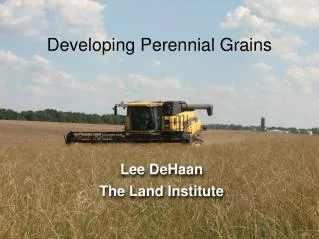
Developing Perennial Grains Lee DeHaan The Land Institute
No-till cropland Central Iowa J. Scheibel 2013 2.8 cm of soil loss reduces productivity by about 7%, due primarily to loss of water infiltration, water holding capacity and nutrient supply Pimental et al. 2004
Field Performance of Starting and Selected Kernza Plants Forage Varieties
168 florets 105 florets 50 florets
Kernza plots in Michigan nearly eliminate leaching of nitrates into the ground water. Organic fertilizer system has less leaching, but the annual wheat still “leaks” much more than the perennial Kernza. Nitrate concentration in water below the root zone (mg/L) Culman et al. 2013
Ray florets per head: • 2006 average= 30, max = 42 • 2008 cross >45; 2010 cross if > 60; • 2012 average = 52, max = 164
Silphium integrifolium Helianthus maxamiliani
Sorghum halepense Sorghum bicolor
PerennialRice • Soil erosion in uplands of southeast Asia has been a serious problem that led to the project of developing perennial upland rice at IRRI (IRRI 1989) Upland Rice in Yunnan, China
Yields of PR 23 perennial (ratooning) rice over 3 harvests (2 years)