Russian Revolution
This article explores the tumultuous history of Russia leading up to the 1917 revolutions. It examines the absolute power wielded by Tsar Nicholas II and his predecessors, the socio-economic struggles of the Russian populace, and key events such as Bloody Sunday and the Russo-Japanese War that shook public confidence in the monarchy. The narrative follows the transition from the Tsarist regime to the establishment of a provisional government, culminating in the Bolshevik Revolution. The transformative impacts of Lenin's policies and Stalin's totalitarianism on Russia are also discussed.

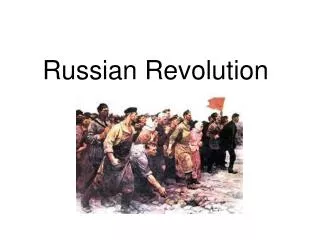
Russian Revolution
E N D
Presentation Transcript
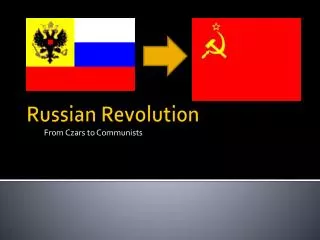
Russian Government Before Revolution • Monarchy: The Czar (Tsar) • Until 1905 the Tsar's powers were unlimited. • No constitution • No political party system to check the Tsar's power • A strong secret police which terrorized the people.
Royal BackgroundNicholas II • Created the first secret police in Russia, brutal leader, response to revolt of army officers in 1825
Czar Alexander II • Abolition of serfdom • 1867 - he sold Alaska to the United States • Killed by the Revolutionary Group: The People’s Will
Czar Alexander III • Industrial Revolution • Harsh against revolutionaries and other liberal movements. • Desired nationalistic movement – Russian language, pogroms
Czar Nicholas II (1894)Last Czar of Russia • Harsh and weak ruler • Economy was bankrupt: • Russo-Japanese War • Entry into WWI became very unpopular.
Russo-Japanese War (1904) Dispute over Manchuria with Japan Shook national confidence in their progress and Czar
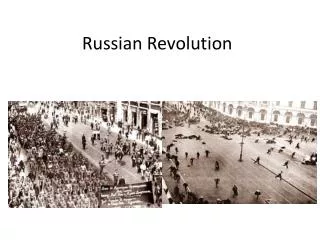
January 22, 1905 • 200,000 workers and families stormed Winter Palace in St. Petersburg – better working conditions • Guards opened fire and killed or wounded 1,000
Russia and World War I • Russia declares war on Austria-Hungary • War becomes unpopular • Rationing leads to starvation • Nicholas II leaves St. Petersburg to war front
Rasputin • Empress Alexandra welcomed Rasputin into court to treat son’s hemophilia • Czar did not trust • Believed to have divine healing powers
March Revolution (1917) • 1917- protests spread through St. Petersburg • Royal palace is taken over • Czar abdicates throne • Provisional government (Duma) takes control • Provisional government unpopular after decision to stay in WWI
October (Bolshevik) Revolution-1917 • Lenin believed: • Power should be in soviet hands • Power passed from bourgeois to proletariat • Modernize country • Lead by VI Lenin “Peace, Land, and Bread” • 1918 March The Bolsheviks accept the peace of Brest‑Litovsk, ending WWI with Germany.
Civil War 1919-1920 • 1919 White Armies (royal, pro-democrats, socialists, Menshevik troops) • Attack the Reds (Bolsheviks) from all directions. • 1920- Reds defeat Whites despite support for White Army from other countries including U.S. • 14 million deaths – war, famine flu
Rule of Lenin 1920-1924 • Economic Reforms included the New Economic Plan (NEP) -moderate mix of capitalism and socialism • Political Reforms -Bolshevik party became Communist Party -Russia becomes the United Soviet Socialist Republics • Empowered women • Universal health care/education
1924 – Stalin “Man of Steel” • Lenin Dies following multiple strokes • Leon Trotsky vs. Joseph Stalin • Lenin did not trust Stalin’s ambition, gruff manner
Characteristics of a Totalitarian State • Dictatorship -Absolute Authority • Dynamic Leader -Vision for the nation • State Control Over All Sectors of Society • Business, Family Life, Labor, youth groups, housing, religion, education, the arts • State Control Over the Individual • Obedience • Denies basic liberties • Organized Violence • Uses force to crush opposition
Stalin’s Totalitarian State • State Control of the Economy • 5 year plan, collective farms • Police Terror • Great Purge, crush opposition • Religious Persecution • Control of the individual • Propaganda (socialist realism) • Molding peoples minds • Education • Controlled by the government
Stalin’s 5-Year Plans • Set impossibly high quotas to increase steel, coal, oil and electricity – most fell short • Collective farming – 90% of peasants lost land – many sabotaged crops • Stalin blamed Kulaks – “wealthy” peasant farmers • Great Famine of 1932-1933
Holodomor 1932-1933 • Ukrainian Genocide – cheap way to starve Ukrainians instead of killing them • 2.2-7 million died