Download
1 / 11
120 likes | 263 Views
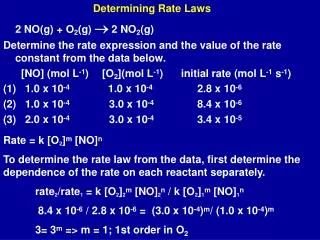
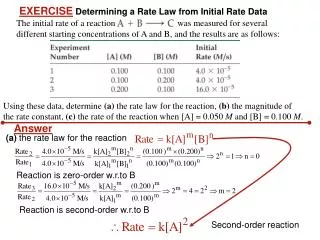
This text provides a detailed exploration of chemical reaction rates and their orders in relation to various reactants. It discusses how the rate of a reaction is influenced by the concentration changes of reactants such as Z, X, and Y, including the determination of rate equations for first, second, and zero-order reactions. Key concepts such as proportionality of rate to concentration and the deducing of overall reaction order are also analyzed. With clear examples, it offers insights into the mathematical relationships governing chemical kinetics.

E N D
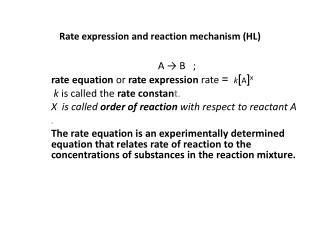
x 3 x 3 • Rate is proportional to change [Z] • Rate 1st order w.r.t. Z • Rate = k [Z] so far
/ 2 • Concentration of X halved • Rate unchanged • Rate zero order w.r.t. X • Rate = k [Z] so far (X term omitted)
x 4 x 16 • Concentration of Y x 4 • Rate x 16 (42) • Rate 2nd order w.r.t. Y • Rate = k [Z] [Y]2
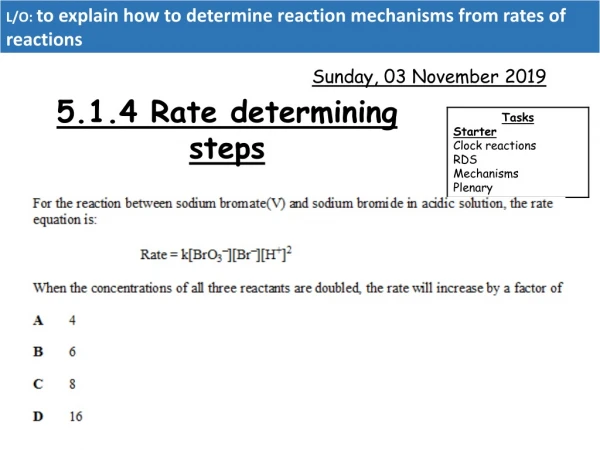
Deduce order w.r.t. A & B. Write rate equation & then calculate ? • [B] x2 and Rate x2 • Reaction is 1st order w.r.t. [B] • Rate = k [B]
Deduce order w.r.t. A & B. Write rate equation & then calculate ? • [A] x2 and Rate x4 (22) • Reaction is 2nd order w.r.t. [A] • Rate = k [B] [A]2
Deduce order w.r.t. A & B. Write rate equation & then calculate ?
[A] x2 and [B] x2 • Rate x8 (23) • This means overall order is 3 • Rate = k [B] [A]2
Rate = k [A]2 [B] x2.52 x 2.5 x6.5 1.0 x 10⁻³
Rate = k [X]2 [Y] ./. 4 ./. 4 0.1
Rate = k [X]2 [Y] x 1.52 x 3 x3 x1.5 x 6.75 0.1 8.1 x 10⁻⁴