
MANNERISM
E N D
Presentation Transcript
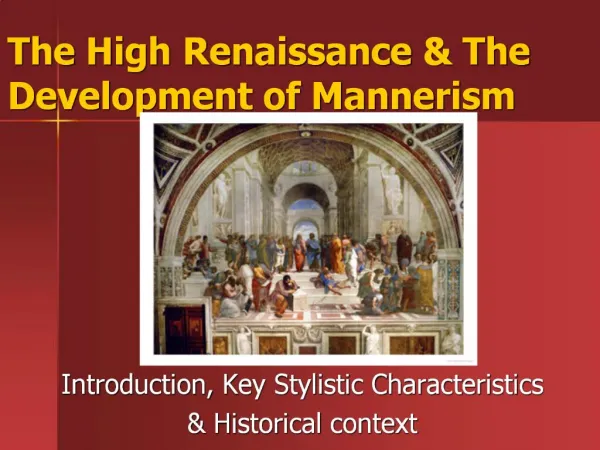
MANNERISM • New movement which replaced the artistic Renaissance in Italy in 1520-1530’s • Mannerism = “in the manner of…” • Deliberate distortion of rules of proportion -> elongated figures showing suffering, anxiety, confusion • Spreads out of Italy • El Greco = greatest mannerist painter – elongated and distorted figures
THE BAROQUE PERIOD • Mannerism is replaced by a new artistic movement – the Baroque • Baroque art begins in Italy in late 16th century • Becomes the art style of the Catholic/Counter Reformation
BAROQUE ART • Use of dramatic effects to stir emotion • Designed to dazzle and wow people • Drama/exuberance/grandeur • Used by Catholic church to communicate religious themes in a dramatic way • In sculpture -> dynamic movement and energy of human forms • In architecture -> bold, dramatic, piling up of details and magnificence – expresses power and control
KEY BAROQUE ARTISTS • Bernini – the colonnade for the piazza at St. Peter’s Basilica/the Ecstasy of St. Teresa • Artemisia Gentileschi – Judith Beheading Holofernes • Caravaggio
FRENCH CLASSICISM • In second half of 17th century France replaces Italy as cultural center of Europe • French Classicism was the style of Louis XIV and his court • Rejected the showy and emotional style of the baroque • Emphasized clarity, simplicity, balance, and order • Focus on themes and style of antiquity…i.e. the classical world • Nicholas Poussin – key artists of French Classicism in painting
DUTCH REALISM • Dutch wealth -> flowering and explosion of Dutch art in 17th century • Dutch burghers commissioned art emphasizing middle class life • Focus on realistic representation of secular everyday life
REMBRANDT • Greatest of the Dutch realist painters of 17th century • Painted numerous self portraits throughout his life • Syndics of the Cloth Guild • The Night Watch
THE WONDEROUS AGE OF THEATER “the bard” THE ELIZABETHAN ERA = PERIOD OF CULTURAL FLOWERING AND LITERARY GENIUS IN ENGLAND • William Shakespeare • Playwright who dominated the Elizabethan Era • Founded and led the Globe Theater in London • Plays exhibit English pride and nationalism • Tragedies – Hamlet, Othello, Macbeth • Comedies – Midsummer Night’s Dream, Measure for Measure, As You Like It • History plays – the Henriad. Richard II
FRENCH THEATER – reflected the classical style - > cool, clever, and polished instead of emotion and imagination • MOLIERE -> comedies • Tartuffe, Le Bourgeois Gentilhomme • RACINE -> tragedies