Glycolytic Pathway: Reactions, Stages & Enzymes
200 likes | 252 Views
This detailed guide explores the glycolytic pathway, where glucose is converted to pyruvate, generating ATP and NADH along two stages comprising enzyme-catalyzed reactions. Learn about the preparatory and payoff stages, key enzymes like hexokinase and aldolase, and the formation of high-energy intermediates. Dive into the mechanism of each reaction and the role of ATP generation. Gain insight into how glycolysis efficiently breaks down glucose to produce energy for cells.


Glycolytic Pathway: Reactions, Stages & Enzymes
E N D
Presentation Transcript
1. The Glycolytic Pathway 2. The Reactions of Glycolysis By: Mohammed Imran Anees Y.B.C.C.P Aurangabad Glycolysis
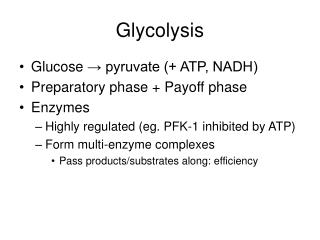
Glycolysis Glucose is converted to pyruvate while generating two ATPs. 2 molecules of NAD+ are converted to 2 molecules of NADH. The oxidizing power of NAD+ must be recycled.
There are 10 enzyme-catalyzed reactions considered to occur in two stages • Stage I (reactions 1-5): Preparatory stage where glucose is phosphorylated and cleaved to yield 2 molecules of glyceraldehyde-3-phosphate (GAP). Stage I uses 2 ATPs. • Stage II (reactions 6-10) Payoff stage where 2 GAPs converted to pyruvate and generation of 4 ATPs. Pathway Overview
1. Hexokinase (first ATP utilization) 2. Phosphoglucose Isomerase (PGI) 3. Phosphofructokinase -1 (PFK-1) (second ATP utilization) 4. Aldolase 5. Triose Phosphate Isomerase (TIM) The Reactions of GlycolysisStage I (Preparatory Stage)
THE PREPARATORY PHASE Step 1 – Hexokinase
Step 2 – Phosphoglucose Isomerase (PGI) [Phosphohexose isomerase] Phosphoglucose Isomerase catalyzes the conversion of G6P to F6P, the isomerization of an aldose to a ketose.
(C) Step 3 - Phosphofructokinase 1: Second ATP utilization
Aldolase catalyzes cleavage of fructose-1,6-bisphosphate (FBP) in reaction 4 of glycolysis. • This forms two trioses • Glyceraldehyde-3-phosphate (GAP) • Dihydroxyacetone phosphate (DHAP). D. Step 4 - Aldolase
Step 4 - Aldolase. Aldol cleavage of FBP to form two Trioses (GAP and DHAP) Note that the atom numbering system changes. Atoms 1, 2, and 3 of glucose become atoms 3,2, and 1 of DHAP. Atoms 4, 5, and 6 become atoms 1, 2, and 3 of GAP.
(E) Step 5 - Triose Phosphate Isomerase (TIM) Only GAP continues along the glycolytic pathway.
6. Glyceraldehyde-3-Phosphate Dehydrogenase (GAPDH) first "High-energy" intermediate formation. • 7. Phosphoglycerate Kinase (PGK): First ATP Generation. • 8. PhosphoglycerateMutase (PGM). • 9. Enolase: second "High-energy" intermediate formation. • 10. Pyruvate Kinase (PK): Second ATP generation. Stage II - payoff phase
(F) Step 6 - Glyceraldehyde-3-Phosphate Dehydrogenase (GAPDH): First “High-Energy” Intermediate Formation.
(G). Step 7 - Phosphoglycerate Kinase (PGK): First ATP Generation.
(I) Step 9 - Enolase: Second “High-Energy” Intermediate Formation. (Dehydration reaction)