Implementation of Conceptual Framework for Ontdeknet: Events and Interventions
This document outlines the contributions and insights gained from the implementation of the Ontdeknet framework within educational environments. It includes detailed deliverables related to cognitive load theory, attention, and motivation in learning processes. The importance of connecting event information to interventions is emphasized, with discussions on reasoning techniques such as rules and agents. The Wizard of Oz method is proposed for validating events and the intervention model, aiming to enhance user engagement while managing cognitive resources effectively.

Implementation of Conceptual Framework for Ontdeknet: Events and Interventions
E N D
Presentation Transcript
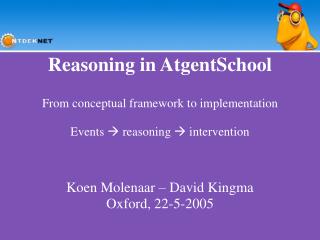
Reasoning in AtgentSchoolFrom conceptual framework to implementationEvents reasoning interventionKoen Molenaar – David KingmaOxford, 22-5-2005
Contribution – WP1 • Deliverable 1.1: • Descriptions of Ontdeknet • Cases of usages within Ontdeknet • English version Ontdeknet • Deliverable 1.2: • Intervention model in the learning proces(Regulate, cognitive, meta-cognitive) • Cognitive load theory • Attention & Motivation
Contribution – WP2 • Deliverable 2.1: • WOZ – insights in events • Clarifying relation general and specific components • Deliverable 2.2: • Analysis of events – interventions within Ontdeknet • Relation conceptual framework – Ontdeknet • Deliverable 2.3 • Set up a general intervention model for Ontdeknet • Validation intervention model with WOz • Deliverable 2.4 • Experiences implementing conceptual framework events
Contribution – WP* • WP3 Deliverable 3.1: • Implementation conceptual framework events in Ontdeknet • WP4 Deliverable 4.1: • WOZ – formative evaluation setup. • WP5 • Czech version Ontdeknet • Teacher presentation Ontdeknet • WP6 • Atgentive on national seminars • WP7 • WP3 Kick off – contributions, tasks and planning
Why reasoning? • We need to connect the event information to interventions. • Asking questions to the user is: • distracting and disturbs the learning process and • user might not provide reliable information. • Adapt to the amount of available data, which depends on the application / environment. • Allowing the atgentive module to adapt the application to the user.
Been there, done that Lots of theory available on reasoning, using: • Rules • Agents • Decision trees • Neural networks • ….
So what’s the problem? • The Atgentive < >application interface is unclear • All applications are different and thus have different kinds of data available • Do we need planning for automated meta-cognitive support? • Can we parameterize all the needed information?
A few examples • Which external event is important to the user, and when should we notify him? • How to decide on the modality of the interaction? • Limited resources available, how to decide if and what other task to propose? • When to re-attract an idle-user attention (when is a user idle?)
Information available A standalone Atgentive module cannot cope with all the information available from the application. For example: • Cognitive load of the user. • Planning of the user and other resources needed for certain tasks • Actions of the application
Information available (II) • Should the application pre-process the data? • Should the application be able to somehow adjust the reasoning parts in the Atgentive module? • Should the application have the last word?
WOz • The Wizard of Oz construction allows to: • Validate Ontdeknet events (WP4) • Validate C.F. events (WP2) • Validate intervention model (WP4) • Validate the separation between application and the Atgentive module • Validate reasoning rules, before coding them • Collect statistical data? More details about the WOz in the afternoon!