Understanding Ocean Floor Features: From Shoreline to Abyssal Plains
Explore the fascinating features of the ocean floor, from the gentle slope of the continental shelf at the shoreline to the steep continental slope that leads to deeper depths. Discover the continental rise formed by sediment deposits, the expansive abyssal plain covered in marine sediments, and the undersea mid-ocean ridges where tectonic plates pull apart. Learn about rift valleys, sea mounts, and the immense ocean trenches formed by plate subduction. This overview provides insight into the intricate geology of our oceans.

Understanding Ocean Floor Features: From Shoreline to Abyssal Plains
E N D
Presentation Transcript
Shoreline • Where water and land meet.
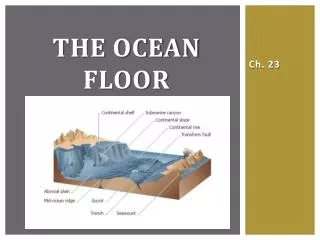
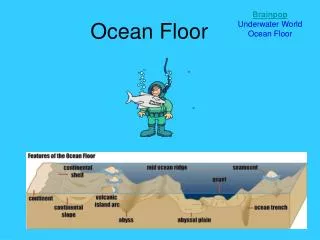
Continental Shelf • Begins at the shoreline and slopes gently toward the open ocean • It continues until the ocean floor begins to slope more steeply downward
Continental Slope • Begins at the edge of the continental shelf • It continues steeply downward to the flattest part of the ocean floor.
Continental Rise • The base of the continental slope • Made of large piles of sediment from mud slides. • The boundary between the continental margin and the deep-ocean basin lies underneath the continental rise.
Abyssal Plain • The broad flat part of the deep-ocean basin • Covered by mud and the remains of tiny marine organisms • Average depth is about 4000m
Mid-ocean Ridges • Are under water mountain chains that form where tectonic plates pull apart. • Rifts form, magma rises to fill the spaces • Heat convection cells in the magma cause the crust on either side to spread apart.
Rift Valley • The pulling motion creates cracks in the ocean floor called rift zones. • As mountains on either side build, a valley forms in the rift zone.
Sea Mounts • Tall, narrow individual volcanic cones generally forming at hot spots or plate boundaries • If it gets tall enough to break the surface of the water, it will become a volcanic island.
Ocean Trenches • Huge cracks in the deep-ocean basin which are abnormally deep. • Trenches form where one oceanic plate is pushed beneath another plate.