Download
1 / 1
10 likes | 137 Views
This paper presents Rollback-Free Value Prediction (RFVP) as an innovative approach to optimize the prediction of approximate loads when cache misses occur, eliminating the need for misprediction checks and rollbacks. By leveraging fast-learning predictors and profile-directed compilation, RFVP aims to enhance application performance and energy efficiency while minimizing quality degradation. Our findings demonstrate up to 2x improvements in energy and performance with minimal quality loss, effectively addressing memory and bandwidth challenges in modern architectures, including GPUs.

E N D
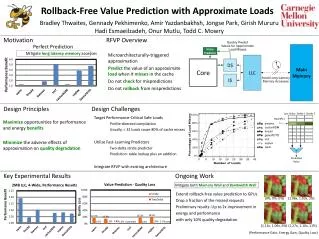
Rollback-Free Value Prediction with Approximate Loads Bradley Thwaites, Gennady Pekhimenko, Amir Yazdanbakhsh, Jongse Park, GirishMururu HadiEsmaeilzadeh, OnurMutlu, Todd C. Mowry Motivation RFVP Overview Perfect Prediction Microarchitecturally-triggered approximation Predictthe value of an approximate loadwhen it missesin the cache Do not checkfor mispredictions Do not rollbackfrom mispredictions • Mitigate long latency memory accesses Design Principles Design Challenges Target Performance-Critical Safe Loads Profile-directed compilation Usually, < 32 loads cause 80% of cache misses Utilize Fast-Learning Predictors Two-delta stride predictor Prediction: table lookup plus an addition Integrate RFVP with existing architecture Maximizeopportunities for performance and energy benefits Minimizethe adverse effects of approximation on quality degradation Key Experimental Results Ongoing Work Mitigate both Memory Wall and Bandwidth Wall 2MB LLC, 4-Wide, Performance Results Extend rollback-free value prediction to GPUs Drop a fraction of the missed requests Preliminary results: Up to 2x improvement in energy and performance with only 10% quality degradation (0%, 0%, 0%) (1.06x, 1.03x, 2%) (1.27x, 1.10x, 11%) (1.13x, 1.06x, 6%) (Performance Gain, Energy Gain, Quality Loss)