Evidence for Evolution
This detailed overview presents the multifaceted evidence supporting evolution. It discusses the fossil record, highlighting transitional fossils that demonstrate the evolutionary journey from ancient to modern species. We explore comparative anatomy, focusing on homologous and vestigial structures, and review embryological and biochemical evidence that showcases genetic similarities across species. Additionally, we delve into adaptation, camouflage, and mimicry, illustrating how organisms evolve traits that enhance survival in their environments. Together, these lines of evidence beautifully illustrate the dynamics of evolution.

Evidence for Evolution
E N D
Presentation Transcript
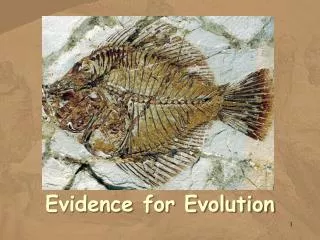
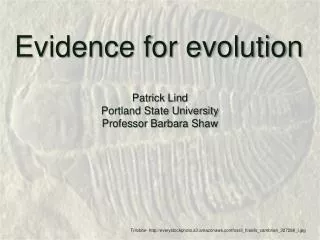
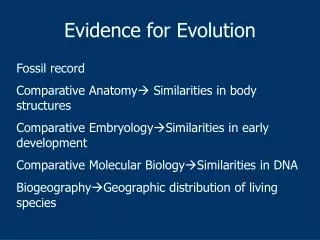
Evolution Support • Fossil Record • Allow us to see the similarities between ancient creatures and modern creatures • Transitional fossils • Show the transitional stages of evolution • Example ----------
Fossil Evidence cont • Derived traits • Newly evolved traits features (such as feathers) that do not appear in the fossils of common ancestors • Ancestral traits • More primitive features such as teeth and tails that do appear in ancestral forms
Comparative Anatomy • Homologous structures • Anatomically similar structures inherited from a common ancestor • The theory of evolution predicts that body parts are more likely to be modifications of ancestral body parts then entirely new features.
Comparative Anatomy • Vestigial structures • Structures that are reduced forms of functional structures. Usually are no longer necessary • Nictitating membrane • Third, usually transparent, eyelid that moves horizontally across the eye.
Comparative Biochemistry • Important Enzymes and other chemicals that are used by the body remain relatively unchanged
A classic experiment took a mouse Pax6 gene and turned it on in a fly's legs. The result? A fly with eyes on its legs. Even though the triggering gene (Pax6) was from a mouse, the eyes that the fly developed on its legs were those of a fly. That's because only the on/off switch (Pax6) was from a mouse; all the genes controlled by it were from a fly. Nevertheless, when the mouse gene said "build an eye," the fly's body understood those directions perfectly, since they both communicate in the same genetic language. These eye-building genes from different animals are so similar that they seem to be interchangeable. In fact, a mouse's or a fly's eye-building gene would probably work just fine in you!
Geographic Distribution • Darwin's observation • Mara occupies a niche in South America similar to the rabbit in Europe. • The Mara is more similar to other South American animals then to the rabbit
Adaptation • Change in a species to make it more fit for its environment • Fitness: How much of a contribution does a new trait make to the survival of an organism • A trait shaped by natural selection • Better adapted = better chance of mating
Camouflage • Some species have evolved morphological adaptation that allows them to blend in with their environment
Mimicry • One species evolves to resemble another species • Usually occurs in harmless species to look like a dangerous species