Understanding Complementary and Supplementary Angles
In this lesson, you will learn how to identify and work with complementary and supplementary angles. Two angles are complementary if their degree measures sum to 90°, while they are supplementary if their measures add up to 180°. Examples of complementary angles include 30° and 60°, whereas 130° and 50° represent supplementary angles. Additionally, you will explore how complementary angles do not require a common side or vertex, enhancing your understanding of angle relationships in geometry.


Understanding Complementary and Supplementary Angles
E N D
Presentation Transcript
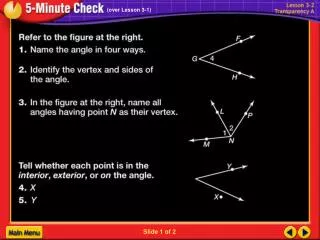
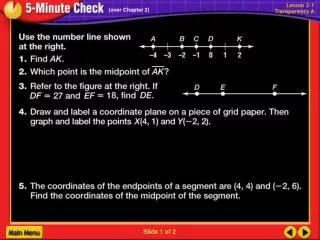
(over Lesson 3-4) 1-1a Slide 1 of 1
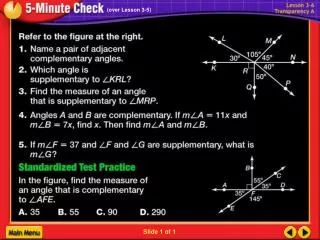
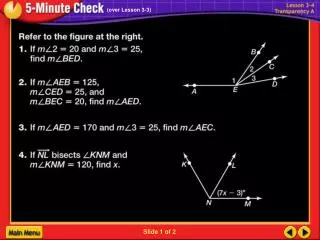
(over Lesson 3-4) 1-1b Slide 1 of 1
§3.5 Complementary and Supplementary Angles What You'll Learn You will learn to identify and use Complementary and Supplementary angles
E D A 60° 30° F B C §3.5 Complementary and Supplementary Angles Two angles are complementary if and only if (iff) the sum of their degree measure is 90. mABC + mDEF = 30 + 60 = 90
E D A 60° 30° F B C §3.5 Complementary and Supplementary Angles If two angles are complementary, each angle is a complement of the other. ABC is the complement of DEF and DEF is the complement of ABC. Complementary angles DO NOT need to have a common side or even the same vertex.
I 75° 15° H P Q 40° 50° H S U V 60° T 30° Z W §3.5 Complementary and Supplementary Angles Some examples of complementary angles are shown below. mH + mI = 90 mPHQ + mQHS = 90 mTZU + mVZW = 90
D C 130° 50° E B F A §3.5 Complementary and Supplementary Angles If the sum of the measure of two angles is 180, they form a special pair of angles called supplementary angles. Two angles are supplementary if and only if (iff) the sum of their degree measure is 180. mABC + mDEF = 50 + 130 = 180
I 75° 105° H Q 130° 50° H S P U V 60° 120° 60° Z W T §3.5 Complementary and Supplementary Angles Some examples of supplementary angles are shown below. mH + mI = 180 mPHQ + mQHS = 180 mTZU + mUZV = 180 and mTZU + mVZW = 180