Download
1 / 5
100 likes | 295 Views
Flame spectroscopy is a technique where atoms are excited by a flame's heat, resulting in their emission of light at different wavelengths, producing various colors. This study explores the spectral emissions of NaCl, Mg, and LiCl. Trials 2 and 3 produced a continuous spectrum indicative of black body radiation, while Trial 1 exhibited a large spike. While NaCl and LiCl melted without burning, they emitted distinct colors at specific wavelengths. Mg burned with self-sustained combustion, emitting bright white light and displaying atomic emission spikes, primarily continuous.

E N D
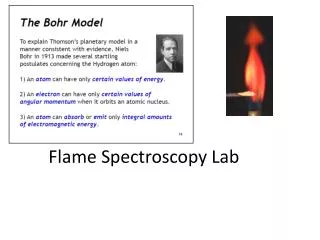
Flame Spectroscopy • The method uses flame excitation • Atoms are exited from the heat of the flame to emit light • Exited atoms glow, emitting light at various wavelengths (therefore varies colors) • Colors are detected by spectrophotometer which measures light intensity as a function of wavelength
F2Cl36H2O Spectra Mixed results Trial 2 and 3 show a more continuous spectrum indicating a black body while trial 1 was continuous with a large spike (?) Not really burning but absorbing the heat and melting quickly Emitted a red orange color while heated
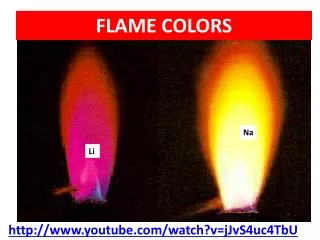
NaCl Spectra • Absorbed the heat not really burning, but melting • Produced single spike around 590nm • Emitted orangish color while heated • Single spike, not continuous so not a black body
Mg Spectrum • Best results of the sources • Mg actually burned, and was a self sustained burn, emitting bright white light • Spikes are due to atomic emission • Mostly continuous meaning black body
LiCl Spectra • Again not really burned but melted • Emitted beautiful, very bright pinkish red color which shows up as the spike at about 670nm • Not continuous therefore not a black body