Download
1 / 10
100 likes | 230 Views
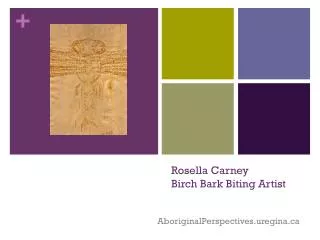
Rosella Carney Birch Bark Biting Artist. AboriginalPerspectives.uregina.ca. Instructions. Show students Video 1: Birch Bark Biting Take some time to discuss what students thought of while they watched the video clip.

E N D
Rosella CarneyBirch Bark Biting Artist AboriginalPerspectives.uregina.ca
Instructions • Show students Video 1: Birch Bark Biting • Take some time to discuss what students thought of while they watched the video clip. • Lead them through the following slides that explain how to do a birch bark biting (or an alternative to birch bark biting). • There is also some informational slides for them to see.
Creating a birch bark biting • In the video clip, Rosella explains that you can fold your piece of birch bark 1, 2, 3 or 4 times. • Once this step is done, you bite your design/shape on one side. • When you open up your folded birch bark you will have a symmetrical design. • What other things in our environment are symmetrical? Take a look around the classroom or browse around in nature.
Don’t have birch bark handy? Try one of these alternatives. • Patty paper (patty paper is what is put between hamburger patties when they are frozen and can be purchased at the grocery store) • Carbon paper (try an office store) • Wax paper (easiest to find and very cheap)
Biography Break: Rosella Carney • Rosella is from Molanosa, Saskatchewan; which is just north of Montreal Lake. • She is one of a handful of people who still practice the art of birch bark biting. • She learned this form of art from a cultural resource teacher. • Rosella also is talented at the art of moose-hair tufting. • She teaches the Cree language. • She currently resides in La Ronge, Saskatchewan.
Choosing a design/shape for your birch bark biting… • When Rosella creates a birch bark biting she first imagines her ideas and shapes out how she wants it to look in her mind. • She finds that circles are the easiest. She creates triangles to represent things like skirts or tipis. • Her favorite designs are of geese, ducks, chickens and other birds. • She is talented at what she does. In the video she shows us a biting she made that represented 8 girls dancing!
Now let’s look at the lines of symmetry found in birch bark bitings
Other Aboriginal art forms where you can find symmetry: • Star blankets • Parfleche bags • Beaded arts • Moccasins