Experimental Design - Variables
This guide explores experimental design by identifying independent, dependent, and constant variables across different scenarios. By practicing with real-life examples, such as the factors affecting plant growth, movie attendance, pizza sales, airplane speed, and rainfall, learners can deepen their understanding of how variables interact. Detailed examples illustrate the process of categorizing variables, providing a framework for conducting effective scientific experiments. Learning to identify these variables is crucial for successful experimentation and data analysis.

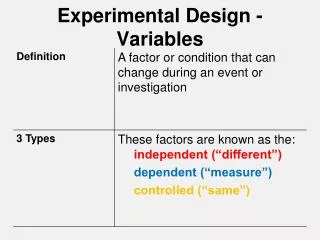
Experimental Design - Variables
E N D
Presentation Transcript
Identifying Variables List four variables that exist for each situation: Ex: What variables can affect the sprouting of a plant seed? 1. amount of water received 2. amount of sunlight 3. amount of fertilizer 4. age of the seed
Practice(List four for each) • What variables can affect the attendance at a new movie? • What variables can affect how many pizzas a restaurant sells? • What variables can affect the speed of an airplane? • What variables can affect the amount of fruit produced by an apple tree? • What variables can affect the amount of rain an area receives?
Practice • List the independent, dependent, and constant variables for each situation: Ex: Students of different ages were given the same puzzle to assemble. The puzzle assembly time was measured. Independent = different ages of students Dependent = assembly time Constant = same puzzle
Indentifying VariablesList the independent, dependent, and constant variables • A study was done to find if different tire treads affect the breaking distance of a car. • A study was done to measure the cleaning effectiveness of different brands of dishwashers. They all had the same water source. • A study was done to see how the length of the blades of helicopters affected their maximum flying speed.