Organizing your New Notebook
170 likes | 218 Views
Set up your science notebook with color coding, title page, table of contents, and notes on physical science concepts. Learn about observation, inference, and prediction techniques. Conduct a Twizzler Lab to identify properties using qualitative and quantitative observations, then conclude with an exit quiz on measurement units. Suitable for students aiming to ace science class.


Organizing your New Notebook
E N D
Presentation Transcript
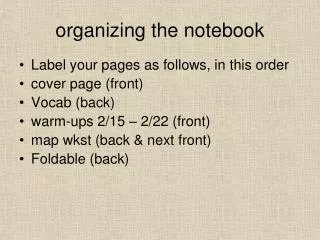
Organizing your New Notebook • Color Code (back cover) • Title Page (1nd page) • Table of Contents (2nd to 4th pages) • Cornel Style Note Taking
Bell Ringer • What unit measures length? • What unit measures mass? • What unit measures weight? • What unit measures volume of liquids? • What does it mean to observe?
What is Physical Science? • Science is the way of learning about the natural world. • Physical Science is the study of matter, energy, and the changes they undergo. • Matter is anything that has mass and takes up space. • Energy is the ability to do work.
Chemistry is the study of the properties of matter and the changes they undergo. • Physics is the study of matter and energy and how they interact.
How Scientists Think… • They use skills of observing, inferring, and predicting to learn more about the natural world.
Observing Observing means using one or more senses to gather information. Two Types: • Quantitative observation • Qualitative observation
Quantitative observation involves numbers. Example: measuring your height or weight. • Qualitative observation describing what you see; doesn’t involve numbers. Example: Noticing that the ball is round or the stove is hot
Inferring • When you explain your observation, you are inferring. • To infer is to make a hypothesis based on what you observed. Example: If you come in and do not see the Bell Ringer up on the projector, you would probably infer that you will not have to do a Bell Ringer today.
Predicting • Predicting means making a forecast of what will happen in the future based on past experiences or evidence. Example: If Charles continues to rob stores, he will get caught. OR It’s cloudy outside, so it will probably rain.
Question • How can I identify the properties of a Twizzler using both qualitative and quantitative observations?
Hypothesis If ________________________, then______________________because___________________.
Procedure • Listen.
Data • Glue data table under your “Data” Section. • Fill in the table based on your observations.
Conclusion • Which of the observations on the data table are quantitative? Which are qualitative? • What state of matter is a twizzler? • What is ductability?
Exit Quiz 8-17-09 • What unit measures length? • What unit measures mass? Convert. • 1.24 m = _______ mm • 65 kL = ______ L • 82 g = _____kg