Geometric Sequences
This comprehensive overview covers the essential definitions and properties of arithmetic and geometric sequences. Learn how to identify each type of sequence based on constant differences and ratios and practice finding the common differences and ratios with various examples. Detailed explanations include finding next terms, determining if sequences are arithmetic or geometric, and deriving formulas to compute terms. Additionally, discover how to sum finite geometric series and apply these concepts to real-world scenarios, ensuring you grasp the fundamentals of sequences in mathematics.

Geometric Sequences
E N D
Presentation Transcript
Geometric Sequences Plus a review of arithmetic sequences
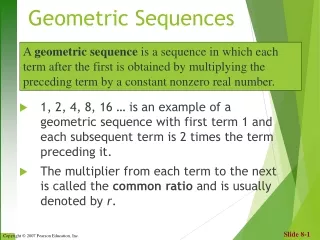
Definitions • Definitions: (yes, that's right, this is important, know these!) • A sequence is a set of numbers, called terms, arranged in some particular order. • An arithmetic sequence is a sequence with the difference between two consecutive terms constant. The difference is called the common difference. ( isn't that clever!) • A geometric sequence is a sequence with a common ratio, r. (cleverness two!) • i.e. The ratio of successive terms in a geometric sequence is a constant called the common ratio, denoted r.
Examples: Find the common ratio of the following: 1) 1, 2, 4, 8, 16, ... r = 2 2) 27, 9, 3, 1, 1/3, ... r = 1/3 3) 3, 6, 12, 24, 48, ... r = 2 4) 1/2, -1, 2, -4, 8, ... r = -2
Examples: Find the next term in each of the previous sequences. 1) 1, 2, 4, 8, 16, ... 32 2) 27, 9, 3, 1, 1/3, ... 1/9 3) 3, 6, 12, 24, 48, ... 96 4) 1/2, -1, 2, -4, 8, ... -16
Let's play guess the sequence!: I give you a sequence and you guess the type. • 3, 8, 13, 18, 23, . . . • 1, 2, 4, 8, 16, . . . • 24, 12, 6, 3, 3/2, 3/4, . . . • 55, 51, 47, 43, 39, 35, . . . • 2, 5, 10, 17, . . . • 1, 4, 9, 16, 25, 36, . . .
Answers! 1) Arithmetic, the common difference d = 5 2) Geometric, the common ratio r = 2 3) Geometric, r = 1/2 4) Arithmetic, d = -4 5) Neither, why? (How about no common difference or ratio!) 6) Neither again! (This looks familiar, could it be from geometry?)
This is important! Arithmetic formula: an = a1 + (n - 1)d an is the nth term, a1 is the first term, and d is the common difference. Geometric formula: an = a1 . r (n - 1) an is the nth term, a1 is the first term, and r is the common ratio.
Sample problems: Find the first four terms and state whether the sequence is arithmetic, geometric, or neither. 1) an = 3n + 2 2) an = n2 + 1 3) an = 3*2n
Answers: 1) an = 3n + 2 To find the first four terms, in a row, replace n with 1, then 2, then 3 and 4 Answer: 5, 8, 11, 14 The sequence is arithmetic! d = 3
2) an = n2 + 1 To find the first four terms, do the same as above! Answer: 2, 5, 10, 17 The sequence is neither. Why?
3) an = 3*2n Ditto for this one ( got it by now?) Answer: 6, 12, 24, 48 The sequence is geometric with r = 2
Find a formula for each sequence. 1) 2, 5, 8, 11, 14, . . . Work: It is arithmetic! So use the arithmetic formula you learned!a1 = 2, look at the first number in the sequence!d = 3, look at the common difference! Therefore, an = 2 + (n - 1)3 and simplifying yields : an = 3n -1 ( tada!) Try putting in 1, then 2, then 3, etc. and you will get the sequence!
2) 4, 8, 16, 32, . . . Work: It is geometric! So use the geometric formula you learned up yonder!a1 = 4, look at the first number in the sequence!r = 2, look at the common ratio!Therefore, an = 4 * 2 (n - 1) Try putting in 1, 2, 3, etc and see if you get the sequence back!
Real – World Connection Suppose you want a reduced copy of a photograph. The actual length of the photo is 10in. The smallest size the copier can make is 64% of the original. Find the length of the photograph after five reductions at 64%.
Quick Check • Find the 19th term in each sequence: • 11,33,99,297… • 20,17,14,11,8…
Don’t Forget • Bring Your Work Books Tomorrow!!! • Unit Exam Friday!! • This Week is Flex Schedule!!
How to find the sum of a finite Geometric Series Sn= a1(1 - rn)/(1 - r) where r is the common ratio and (r doesn't = 0) To find the sum of a finite geometric series, you need to know three things: the first term, how many terms to add and the common ratio!! (piece of cake!)
Definition geometric series - the expression formed by adding the terms of a geometric sequence. Finding the Sum of the First n Terms of a Geometric Sequence. • Use Sn = [a1(1 - rn)/(1 - r)], Sn is the sum of the first n terms. • Substitute the n, a, and r values into Sn = [a1(1 - rn)/(1 - r)]. • Simplify to find the sum.
Example problem: Find the sum of the first 10 terms of the geometric series:4, 8, 16, 32, 64, . . . Answer: t1 = 4 r = 2t10 = 4 . 29 = 2048 (This is the formula for a geometric sequence!) Therefore:Sn = [a1(1 - rn)/(1 - r)], S10 = 4(1-210)/(1 - 2) = 4 . 1023 = 4092
Example: Find the sum of the first 10 terms of the geometric series 9 + 36 + 144 + 576 + ... Answer: Sn = [(1 - rn)/(1 - r)] Sn = [9(1- 410)/(1-4)] Sn = [9(-1048575)/(-3)] Sn = 28,311,525
Example: Find the sum of the first 10 terms of the geometric series -6 + -30 + -150 + -750 + ... Answer: Sn = [(1 - rn)/(1 - r)] Sn = [-6(1- 510)/(1-5)] Sn = [-6(-9765624)/(-4)] Sn = -234,374,976
Example: Find the sum of the first 10 terms of the geometric series 8 + 56 + 392 + 2744 + ... Answer: Sn = [(1 - rn)/(1 - r)] Sn = [8(1- 710)/(1-7)] Sn = [8(-282,475,248)/(-6)] Sn = 13,558,811,900
Example: Find the sum of the first 10 terms of the geometric series 4 + 12 + 36 + 108 + ... Answer: Sn = [(1 - rn)/(1 - r)] Sn = [4(1- 310)/(1-3)] Sn = [4(-59,048)/(-2)] Sn = 472,384