Understanding Key Robotics Terms: Definitions and Applications in Industry
This document defines essential robotics terms, including Garbage In-Garbage Out, Logic, Program, and Robot. It highlights how robots carry out complex tasks automatically in various industries such as automobile manufacturing, agriculture, construction, healthcare, and more. The terms discussed emphasize the importance of valid input data for meaningful output, and they illustrate the diverse applications of robotics in sectors like entertainment, law enforcement, and hazardous environments. A comprehensive understanding of these terms is crucial for anyone interested in the field of robotics.

Understanding Key Robotics Terms: Definitions and Applications in Industry
E N D
Presentation Transcript
Robotics Unit 8
Terms/Definitions • Garbage In-Garbage Out—This term refers to the fact that computers will process nonsensical, faulty, or incomplete input data and produce nonsensical, faulty, or incomplete output. • Logic—Reasoning conducted or assessed according to strict principles of validity • Program—provide a computer or other machine with coded instructions for the automatic performance of a particular task • Robot—A machine capable of carrying out a complex series of actions automatically
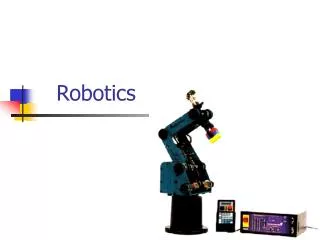
Uses in Industry • Welding • Spray painting • Assembly tasks • Palletizing & Material Handling (semiconductor IC chip) • Dispensing Operations • Laboratory Applications • Water Jet Cutting • Work Cell
Types of Industry that Use Robots • Automobile—weld, paint, assembly • Agriculture—crop harvest, animal grooming and care • Construction—welding, floor finishing • Entertainment—toys, humanoids • Health care—hospitals, surgery, research • Laboratories—science, engineering, research • Law enforcement—surveillance, patrol • Manufacturing—assembly, packing, painting, welding • Military—demining, surveillance, attack • Mining, excavation, exploration • Transportation—air, ground, rail, space • Utilities—gas, water, electric readings • Warehouses—material movement • Space—research, testing • Hazardous environments—material handling • Home—cleaning, monitoring, entertainment