Understanding Causes and Future of Climate Change: Insights from Muir Glacier Data
Join us for a comprehensive exploration of the causes of recent warming trends, with a focus on Muir Glacier's historical data from 1941 and 2004. We will examine greenhouse gas impacts, tectonic movements, and natural oscillations, alongside anthropogenic influences like CO2 and methane. Learn about the interplay of factors, including sulfate aerosols and brown clouds, which affect global temperature. This series will culminate in a discussion about future climatic changes and perspectives ahead of the wrap-up on April 27.

Understanding Causes and Future of Climate Change: Insights from Muir Glacier Data
E N D
Presentation Transcript
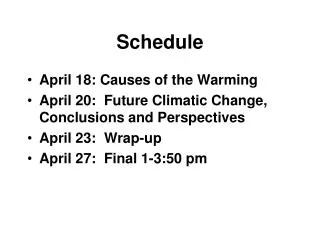
Schedule • April 18: Causes of the Warming • April 20: Future Climatic Change, Conclusions and Perspectives • April 23: Wrap-up • April 27: Final 1-3:50 pm
Muir Glacier 1941 Causes of the recent warming Muir Glacier 2004
What is the cause of the recent warming? • We have had about 0.7C of warming over the last 100 years • Clearly there are more greenhouse gases in the atmosphere….. • But what is the context? • Other long-term changes • Tectonic: The northern movement of the continents produces a slow cooling ~ 5-10C over the past 100 Myrs • Insolation has been dropping. This amounts to about 1C over the last 6000 years • Millennial-Scale oscillations?
CO2 • We have very good data on the natural range of CO2 during the past glaciations from the ice bubbles. • An aside on natural sources of CO2 • We passed the maximum natural range about 1900…. • At that point fossil fuels were only a fraction of total human carbon input
200 Million Tons All volcanic inputs
CO2 • About half stays in the atmosphere • 15-20% goes into the biosphere • There are places with substantial “reforestation” (Eastern US for example) • Faster plant growth • 25-30% into the shallow ocean • CO2 is more easily dissolved in cold water
Methane • Even more extreme story with Methane. • We were outside the natural range well before the industrial revolution • Human sources are about double all natural sources • Methane accounts for about 16% of the total greenhouse-gas effect.
Let’s Pretend….. The short-term climate is driven by: The Sun Spot Cycle Dust from volcanic explosions ENSO (El Nino Southern Oscillation) “Anthropogenic Influence” Atmospheric CO2 buildup
Let’s Pretend….. The yellow line is the sum of JUST these 4 factors The black line is the instrumental surface temperature record (i.e. reality) Works pretty good…hunh? Make some predictions……?
Sulfate Aerosols • Like many things, the role of SO2 is complex • Like water….as a vapor SO2 it is a greenhouse gas, as a particle it has a cooling effect • BUT, it reacts with water vapor to form sulfate particles (and sulfuric acid…acid rain)
Brown Clouds • These are essentially smog due to human activity • Stoves • Cooking fires • Two effects • Absorb solar radiation and heat lower atm (2-3 km altitude) • Blocks Sunlight producing ground cooling • May effect the monsoons
Brown Clouds • This is not just a problem in Asia or China • What do you know about the 1952 London Smog? • December 5-9 • The fog there was so thick that people could not see their own feet! • About 4,000 people died (maybe as many as 12,000)
Global Dimming • Because of aerosols pollution, the brightness of the Earth's surface has dropped about 7% • This probably represents a net cooling due to more sunlight being reflected by the increased particle load in the atmosphere
Radiative Forcing • Remember, the Earth has a natural greenhouse effect • The greenhouse gases we have added has enhanced the back radiation by about 2.7 W/m2
But….the warming is actually pretty small… • We have increased CO2 by 35%, equivalent CO2 by 60% • Why ONLY a 0.7C temp increase? • Ocean Thermal Inertia • Aerosols • Insolation
The net effect of the various sources of radiative forcing is still a bit tough to sort out.