Enhancing Literacy through Collaborative Teacher Leadership and Data-Driven Interventions
This initiative focuses on fostering a comprehensive literacy program led by informed teacher teams and school administrators. By building prior knowledge and systematically increasing text complexity, we can effectively address reading and writing instruction. Essential components include scheduling interventions, collaborative skills development, and the utilization of data-driven decision-making. With frameworks from the Big Ideas in Reading and the National Institute for Literacy, educators will access reliable evidence-based resources to enhance strategies for reading instruction, fostering greater student achievement.

Enhancing Literacy through Collaborative Teacher Leadership and Data-Driven Interventions
E N D
Presentation Transcript
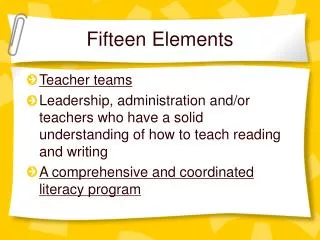
Fifteen Elements • Teacher teams • Leadership, administration and/or teachers who have a solid understanding of how to teach reading and writing • A comprehensive and coordinated literacy program
Part of the Solution • Planning teams • Scheduling intervention • Scheduling interaction • Need for collaboration skills • Capacity building • collaboration • Considering data and the continued use of data driven decisions
RtI Interventions • Let’s take a few minutes and consider the interventions we are currently using or considering: • Tier One • Tier Two • Tier Three • What are some? • What is the Research behind these interventions?
RtI Resources on the Web • Best Evidence Encyclopedia (B.E.E.) This website offers reliable, unbiased information on high-quality evaluations of educational programs.
Oregon’s Big Ideas • Big Ideas in Beginning Reading Focuses on BIG IDEAS of early literacy: phonemic awareness, alphabetic principle, fluency with text, vocabulary, and comprehension.
Type of Program 1 = Core Reading Program 2 = Supplemental or Intervention Program 3 = Technology-Based Program 4 = Program that may be implemented by a tutor or mentor 5 = Intervention or Remedial Program for students above third grade Reading Component PA = Phonemic Awareness P = Phonics F = Fluency V=Vocabulary C = Comprehension + = some aspects of this component taught and/or practiced ++ = most aspects +++ = all aspects n/a = not addressed FCRR Key
What We Know • National Institute for Literacy - nifl.gov • The National Institute for Literacy, a federal agency, provides leadership on literacy issues, including the improvement of reading instruction for children, youth, and adults.
What We Know • What Works Clearninghouse • ies.ed.gov/ncee/wwc • Institute of Education Science’s Database sharing what we know about related research specific to standards and the research arm of NCLB.
RtI Action Network • A program of the National Center for Learning Disabilities • Offers a guide educators and families in the large-scale implementation of RTI • Access research reports • How to tips • Temperature of what is happening in the field
National Center on RtI • Technical assistance to states and districts and building the capacity of states to assist districts in implementing proven models for RTI. • Reports • Products for consideration • Evidence-based practices for High School • Considerations for implementation
Advancing Literacy • Initiative by the Carnegie Corporation • Funded reports and research on • adolescent literacy • What works • What we need to be doing at the middle/high school level
Using Data to Improve Instruction Using Data to Improve Instruction Using Data to Raise Student Achievement Usable Knowledge
What We Know • KU’s Center on Research and Learning • http://www.ku-crl.org/projects/ • Strategic Instruction Model • http://www.ku-crl.org/sim/