Understanding Visual Descent Point (VDP) Timing and Height Above Touchdown (HAT) Calculations
40 likes | 205 Views
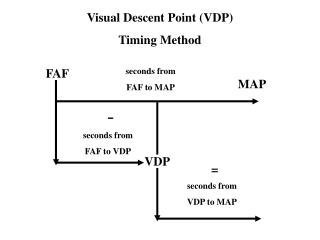
This guide explores the Visual Descent Point (VDP) timing method, emphasizing calculations for FAF to MAP and VDP to MAP in relation to the Height Above Touchdown (HAT). By analyzing descent profiles, the document provides insights into maintaining safe vertical speed and timing during approach. Key examples illustrate how to calculate distances and descent rates in various scenarios, fostering better situational awareness and approach management for pilots. Mastering these calculations ensures compliant and safe descents during landing.


Understanding Visual Descent Point (VDP) Timing and Height Above Touchdown (HAT) Calculations
E N D
Presentation Transcript
Visual Descent Point (VDP) Timing Method FAF seconds from FAF to MAP MAP - seconds from FAF to VDP VDP = seconds from VDP to MAP
Visual Descent Point (VDP) Height Above Touchdown (HAT) Method FAF 1600 MSL MAP VDP MDA 600 MSL HAT = 1600 - 200 = 1400 1400/300 = 4.67 NM TDZE 200 MSL 300 feet per NM
Visual Descent Point (VDP) Height Above Touchdown (HAT) Method GS = 90 Distance travelled = 1.5 NM per minute 4.67/1.5 = 3 minutes 1400 feet/3 minutes = 500 FPM OR using HAT/600 2.33/1.5 = 1.5 minutes 1400 feet/1.5 minutes = 900 FPM