Download
1 / 6
60 likes | 177 Views
Imagine a world devoid of sensory experiences—where the vibrant sensations of touch, sound, sight, smell, and taste fade away. In Ronald Kotulak's exploration of the human brain, he highlights its incredible capacity to create music, dreams, and transformation, but also its vulnerability to deterioration when deprived of stimuli. This profound connection to our surroundings is not just a scientific curiosity; it reflects our very humanity. Understanding this invites us to enhance our sensory experiences and appreciate their integral role in cognition and emotion.

E N D
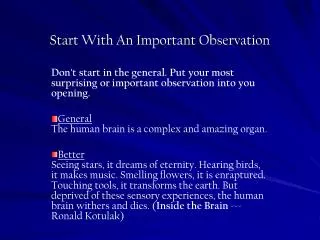
Start With An Important Observation Don't start in the general. Put your most surprising or important observation into you opening. GeneralThe human brain is a complex and amazing organ. BetterSeeing stars, it dreams of eternity. Hearing birds, it makes music. Smelling flowers, it is enraptured. Touching tools, it transforms the earth. Butdeprived of these sensory experiences, the human brain withers and dies. (Inside the Brain --- Ronald Kotulak)
Put your connection with the subject in the lead. Why are you attracted to the subject? Do you have a personal reason for writing about this subject? What specific memories of the subject come to mind? • GeneralThe problem of longitude was one of the greatest scientific challenges of its day. • BetterOnce on a Wednesday excursion when I was a little girl, my father bought me a beaded wire ball that I loved. At a touch, I could collapse the toy into a flat coil between my palms, or pop it open to make a hollow sphere. Rounded out it resembled a tiny Earth, because its hinged wires traced the same pattern intersecting circles that I had seen on the globe in my school room -- the thin black lines of latitude and longitude. (Longitude --- Dava Sobel)
Flaunt your favorite bit of research in the lead. Start with the facts that made you smile, laugh, go "ahaaa" or just plain grossed you out. • GeneralDid you ever wonder why God created flies? • BetterThough we've been killing them for years now, I have never tested the folklore that with a little cream and sugar, flies taste very much like black raspberries.
Start With A Bold or Challenging Statement. It is meant to cause some people to disagree with what you say, like one side of an argument. • Example: Using horses and cattle in the sport of rodeo is animal abuse. What makes it more aggravating is that it is legal. According to the law, there is nothing wrong with chasing an animal down, tightening a rope around its neck, knocking it to the ground, and tying its legs together so it cannot move.
Use a quotation. Quote a famous saying that is directly related to your topic. • Example: President John F. Kennedy once said, "Ask not what your country can do for you, ask what you can do for your country." I think today's Americans have forgotten Kennedy's message. We expect our country to take care of us, but we are not taking care of our country.
Start with a strongly stated question your readers might have. In some ways all writing is about trying to answer our best questions. A strong question is one we all want to know the answer to. • Weakly-statedIn this paper I will attempt to answer the question why history is important. • BetterWhat's the point of studying history? Who cares what happened long ago? After all, aren't the people in history books dead?