1 / 5

Understanding Retrograde Motion: Ptolemy vs. Copernicus

This text explores how retrograde motion, such as that of Mars, is explained in both the Ptolemaic and Copernican models of the solar system. In Ptolemy's model, this motion is attributed to the epicycle moving along the deferent, while in Copernicus's model, it arises from the combined motions of Earth and Mars, highlighting that more distant planets move more slowly. Although both models yield mathematically equivalent explanations, their physical interpretations are significantly different. This comparison is extended to Venus, with similar dynamics at play, but with reversed planetary roles.

jane
Download Presentation

Understanding Retrograde Motion: Ptolemy vs. Copernicus

An Image/Link below is provided (as is) to download presentation Download Policy: Content on the Website is provided to you AS IS for your information and personal use and may not be sold / licensed / shared on other websites without getting consent from its author. Content is provided to you AS IS for your information and personal use only. Download presentation by click this link. While downloading, if for some reason you are not able to download a presentation, the publisher may have deleted the file from their server. During download, if you can't get a presentation, the file might be deleted by the publisher.

E N D

Presentation Transcript


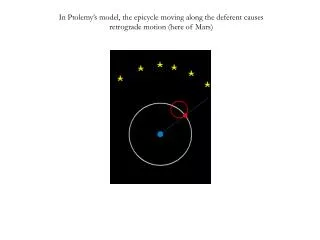
  1. In Ptolemy’s model, the epicycle moving along the deferent causes retrograde motion (here of Mars)

  2. In the Copernican model, retrograde motion arises naturally from the dual motion of Earth and Mars. One key is that more distant planets move more slowly.

  3. The Copernican system’s and Ptolemaic system’s explanations of retrograde motion are mathematically equivalent. But the physical causes are very different.

  4. Retrograde motion for Venus (right) works the same way, only the roles of the planets are reversed.

More Related