Understanding Scientific Notation and Measurement Units in Science
Scientific notation simplifies the handling of extremely large or small numbers. It expresses numbers as a product of a number between 1 and 10, and a power of ten. For example, the mass of a proton is written as 1.7262 x 10^-27 kg. This notation is useful for addition, subtraction, multiplication, and division of significant figures. Additionally, the International System of Units (SI) outlines standard measurements, including base units like seconds, meters, and kilograms, along with derived units for volume and density, ensuring clarity among scientists.

Understanding Scientific Notation and Measurement Units in Science
E N D
Presentation Transcript
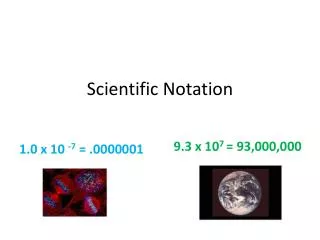
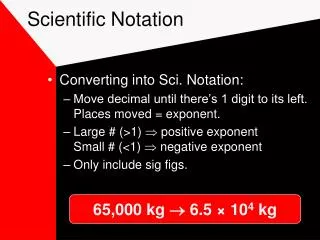
Scientific Notation • Numbers that are extremely large can be difficult to deal with…sooo • Scientists convert these numbers into scientific notation • Scientific notation expresses numbers as a multiple of two factors: • A number between 1 and 10 (only 1 digit to the left of the decimal!) • Ten raised to a power
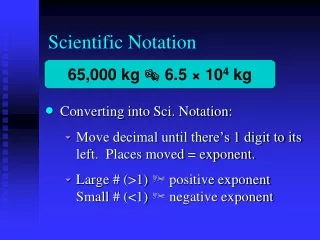
For example: A proton’s mass =0.0000000000000000000000000017262 kg If you put it in scientific notation, the mass of a proton is expressed as 1.7262 x 10⁻²⁷ kg Remember: When numbers larger than 1 are expressed in scientific notation, the power of ten is positive When numbers smaller than 1 are expressed in scientific notation, the power of ten is negative
Try these: Convert 1,392,000 to scientific notation. = 1.392 x 10⁶ Convert 0.000,000,028 to scientific notation. = 2.8 x 10⁻⁸
Adding and Subtracting using Scientific Notation • Make sure the exponents are the same!! 7.35 x 10² + 2.43 x 102 = 9.78 x 10² • If the exponents are not the same, you have to make them the same!! • Tip: if you increase the exponent, you decrease the decimal ----- if you decrease the exponent, you increase the decimal • Example: Tokyo pop: 2.70 x 10⁷ Mexico City pop: 15.6 x 106 = 1.56 x 10⁷ Sao Paolo pop: 0.165 x 108 = 1.65 x 10⁷ NOW you can add them together and carry thru the exponent Total= 5.91 x 10⁷
Multiplying and Dividing using Scientific Notation • Multiplication: • Multiply decimals and ADD exponents • Ex : (1.2 x 106) x (3.0 x 104) = 3.6 x 10¹⁰ 6 + 4 = 10 • * Ex: (1.2 x 106) x (3.0 x 10-4) = 3.6 x 10² 6 + (-4) = 2 • Division: • Divide decimals and SUBTRACT exponents • Ex: (5.0 x 10⁸) ÷ (2.5 x 10⁴) = 2.0 x 10⁴ 8 – 4 = 4 • *Ex: (5.0 x 10⁸) ÷ (2.5 x 10⁻⁴) = 2.0 x 10¹² 8 – (-4) = 12
Units of Measure • SI units: SystemeInternationale d’ Unites • standard units of measurement to be understood by all scientists • Base Units: defined unit of measurement that is based on an object or event in the physical world • there are 7 base units • some familiar quantities are time, length, mass, and temp
Time • second (s) • Many chemical reactions take place in less than a second so scientist often add prefixes, based on multiples of ten, to the base units. • ex. Millisecond Length • meter (m) • A meter is the distance that light travels though a vacuum in 1/299 792 458 of a second. • What is a vacuum? • Close in length to a yard. • Prefixes also apply…ex. millimeter
Mass • mass is a measurement of matter • kilogram (kg) • about 2.2 pounds • Masses measured in most laboratories are much smaller than a kilogram, so scientists use grams (g) or milligrams (mg). • How many grams are in a kilogram? • 1000 • How many milligrams are in a gram? • 1000
Derived Units • Not all quantities are measured in base units • A unit that is defined by a combination of base units is called a derived unit. • Volume and Density are measured in derived units.
Volume • The space occupied by an object • Unit = cm3 = mL • Liters are used to measure the amount of liquid in a container (about the same volume as a quart) • Prefixes also applied…ex. milliliter